 Storm Software
Home / Free tools / Macro Calculator
Macro calculator
Work out daily calories and macros from age, sex, height, weight and activity. Pick a goal, set protein and fat, and the carbs fill in the rest. Works in kg and cm or lb and inches.
- Free to use
- No sign-up
- Runs in your browser
- Nothing you type is sent anywhere
About you
Daily targets
This is an estimate to start from, not medical advice. Adjust it every few weeks based on real progress, and speak to a doctor or registered dietitian if you have a medical condition.
Want to save this and come back to it? Storm Coach keeps everything on your own device. See Storm Coach.
Coach more clients without a subscription
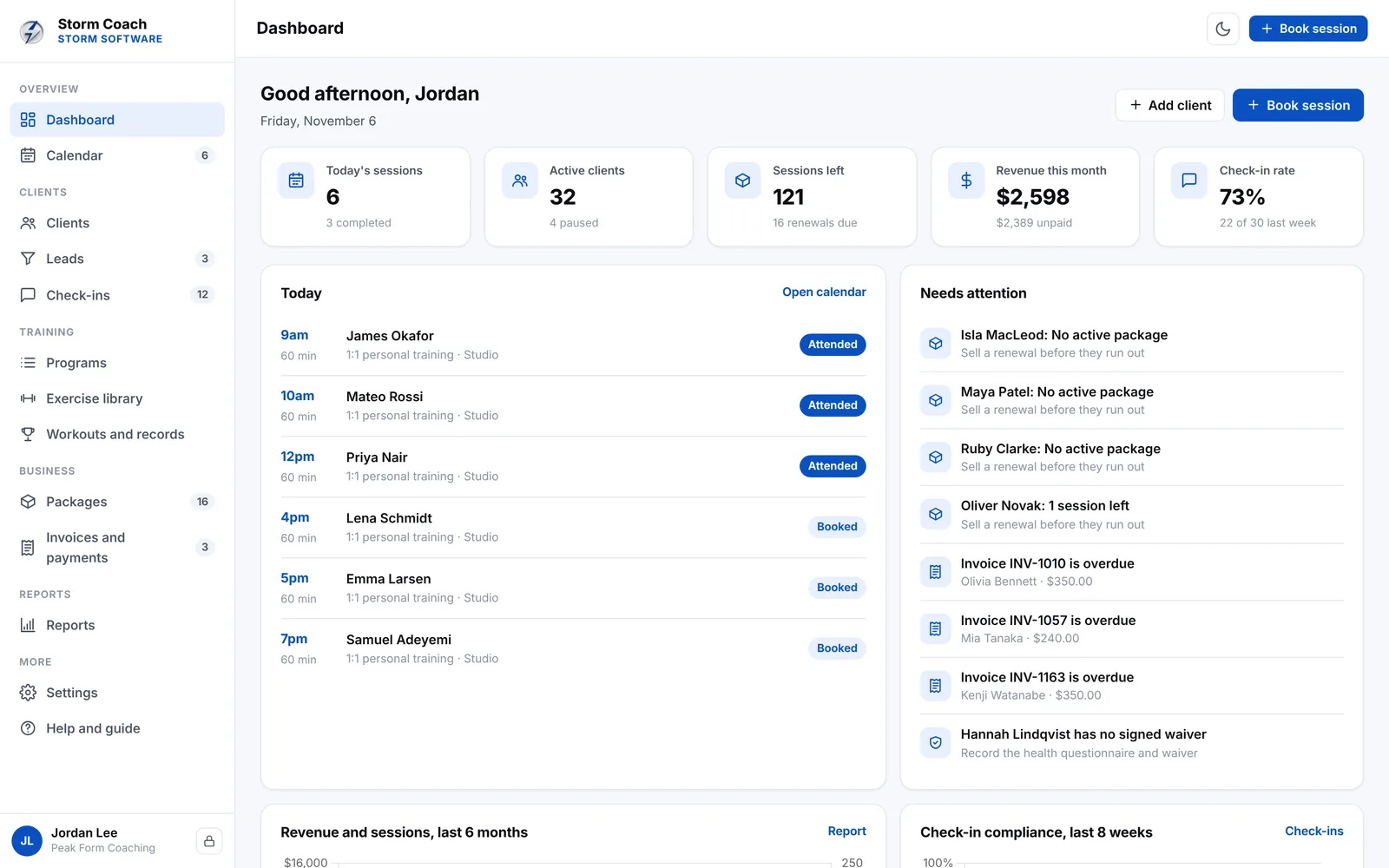
Storm Coach handles your calendar, packages, programs, workout logs, check-ins and client progress, with macro targets saved to every client. It works offline on your laptop, phone or tablet, and your client records stay on your own device.
- Sessions and packages
- Program builder
- Progress and macros
- Pay once, no monthly fees
One payment. No subscription. Works offline and your data stays on your device.
How this macro calculator works
The calculator starts with your resting energy burn, then scales it for activity and your goal, and finally splits the calories into protein, fat and carbohydrate.
Resting burn: Mifflin-St Jeor
Basal metabolic rate (BMR) is estimated with the Mifflin-St Jeor equation: 10 x weight in kg, plus 6.25 x height in cm, minus 5 x age, plus 5 for men or minus 161 for women. It is one of the most widely used equations for healthy adults.
Maintenance calories
BMR is multiplied by an activity factor, from 1.2 for mostly sitting to 1.9 for very hard training or a physical job. The result is total daily energy expenditure, the calories needed to hold your weight steady.
Goal adjustment
For fat loss a 10 to 20% deficit is a common, sustainable starting point. For muscle gain a small surplus of around 10% limits fat gain. Re-check every two to four weeks and adjust based on real results.
Protein, fat and carbs
Protein is set per kg or lb of body weight, with 1.6 to 2.2 g per kg (about 0.7 to 1 g per lb) common for people who train. Fat is set as a share of calories, often 20 to 35%. Carbohydrates fill the remaining calories. Protein and carbs have 4 kcal per gram and fat has 9.
Read more: How to price personal training packages.
Frequently asked questions
How accurate is this calculator?
It is an estimate. Equations like Mifflin-St Jeor are close for many people but not exact, so treat the result as a starting point and adjust from real progress.
How much protein should I eat?
Many people who train aim for 1.6 to 2.2 g per kg of body weight, or about 0.7 to 1 g per lb. Change the protein field to suit you.
How big should a calorie deficit be?
A 10 to 20% deficit is a common starting point for fat loss. Larger deficits are harder to stick to and can cost muscle.
Can I use pounds and feet?
Yes. Switch to lb and ft and the weight, height and protein setting are converted for you.
Is this medical advice?
No. It is a general estimate. Speak to a doctor or registered dietitian if you have a medical condition, are pregnant, or are under 18.
More free tools
Quick calculators and planners for home, family and small business. All free, all in your browser.