
How to Price Personal Training Packages: A Practical Guide for Coaches
Most new trainers price by looking at the gym down the road. That tells you what the market will accept, but not whether the price works for you. A good pricing plan starts with your own numbers, then turns them into packages that are easy to buy and easy to keep. This guide walks through each step, from your hourly floor to cancellation rules and price rises.
Start with your hourly floor
Before you look at anyone else's prices, work out the least you need to earn for each hour you coach. Add up a year of costs: gym rent or floor fees, insurance, certifications and education, equipment, software, marketing, phone and travel. Add the income you want to take home, then gross it up for tax.
Divide that total by the number of sessions you can realistically deliver in a year. Be honest here. Holidays, cancellations, quiet months and admin time all reduce the hours you actually get paid for. The result is your floor: the price per session below which the business loses money.
- Count only paid coaching hours, not programming, messages and travel
- Allow for quiet months, holidays and sick days
- Review the floor every year, because costs rise
The same floor method is used by photographers; see how photographers work out their minimum price.
Single sessions, packs or memberships?
Single sessions are simple, but they make every week a fresh sale and clients drift away easily. Most coaches move toward session packs and monthly memberships, because they bring predictable income and better results for clients who turn up consistently.
Session packs, such as 10 or 20 sessions, suit clients who want flexibility. Monthly memberships, such as two sessions a week billed monthly, suit clients who want a routine. Many coaches offer both, plus a single session price that sits clearly above the per session cost of a pack.
How much to discount bigger packages
Discounts reward commitment, but they come straight out of your margin. A common pattern is a modest saving for a 10 pack and a little more for a 20 pack, rather than steep cuts. The aim is to make the bigger package the obvious choice without giving away an hour of your time for free.
Check every package price against your hourly floor. If a 20 pack takes your effective rate below the floor, shrink the discount or add value that costs you little, such as a written program or a monthly check in, instead of cutting the price.
Expiry dates and late cancel rules
Packages without an expiry date pile up as unused sessions you still owe, sometimes for years. A clear expiry, such as 10 sessions within 12 weeks, keeps clients consistent and protects your calendar.
Set a late cancel window, often 12 or 24 hours, and decide whether a late cancel or no show uses a session. Put the rule in writing when the client buys, and apply it the same way every time. Clients respect consistent rules far more than surprise charges.
Group and small group training
Small group sessions let you charge each person less while earning more per hour. Two to four people sharing a session can each pay well under your one to one rate, and your hourly income still rises. Set a capacity so the session stays personal, and decide what happens if only one person turns up.
Online coaching and programs
Written programs, remote check ins and nutrition targets can be sold on their own or added to in person packages. Price them on the time they really take each week, including messages and adjustments, not as a free extra.
If you set calorie and macro targets, explain that they are a starting point and adjust them from real progress. Refer clients with medical conditions to a doctor or registered dietitian.
Work out a client's starting targets with our free macro calculator. It uses the Mifflin-St Jeor equation and works in kg or lb.
When to raise your prices
Signs it is time: your calendar is full, you have a waiting list, your costs have gone up, or you have added qualifications and results. Raise prices for new clients first, give existing clients notice of a month or more, and consider letting loyal clients keep their rate for a while.
Small, regular rises are easier for clients than a large jump after years of the same price.
Keep packages simple to run
Packages only work if you track them. Every client needs to know how many sessions are left, when the pack expires and when it is time to renew. Doing that in a notebook or spreadsheet is where sessions get missed and renewals slip.
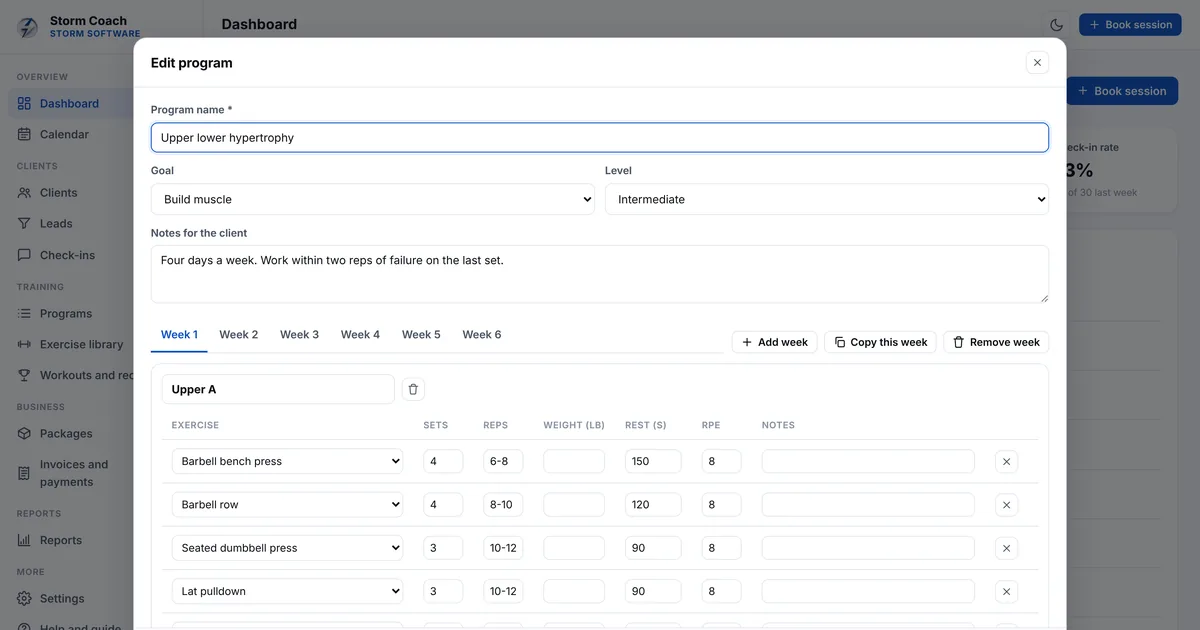
Storm Coach tracks packs and memberships for you. Attended sessions come off the right package automatically, late cancels follow your rule, and renewals due show up on the dashboard, alongside programs, workout logs and progress tracking.
See how Storm Coach handles sessions, packages and client progress for $99 once, with no monthly fees.
For getting paid on time, read our guide to invoicing software for small businesses.
Common pricing mistakes to avoid
The most common mistake is pricing below your floor to win clients, then finding there is no room to raise prices without losing them. It is easier to start at a fair rate and offer a short introductory package than to climb from a rate that never worked.
Other mistakes are quieter. Offering unlimited messaging inside a cheap package, letting packs run with no expiry, waiving late cancel rules for some clients but not others, and forgetting to bill sessions that were never part of a package. Each one costs a little, and together they can wipe out a good month.
- Do not compete on price alone; compete on results and service
- Write down what each package includes and what it does not
- Bill for extra sessions the same week they happen
Present your prices clearly
Clients compare prices quickly, so make yours easy to read. Show the per session cost of each package next to the single session price, so the saving is obvious. Explain what is included, such as a program, check ins or nutrition targets, and keep the number of options small. Two or three packages plus a single session is plenty for most coaches.
A short consultation before the first purchase helps too. It lets you understand the client's goals, recommend the right package and set expectations about attendance, expiry and cancellations before money changes hands.
The bottom line
Work out your hourly floor, build packages and memberships that sit comfortably above it, keep discounts modest, write down your expiry and cancellation rules, and review your prices every year. Clear, consistent pricing makes selling easier and keeps your business healthy.
Try our free macro calculator.
You may also like: Storm Fitness, Storm Weight, Storm Meal Planner