
How to Price Photography: The Formula, a Worked Example and Package Ideas
To price photography, add up what your business costs to run in a year and the income you want to take home (before tax), then divide by the number of hours you can realistically work on client sessions. That gives your minimum hourly rate. Multiply it by the real hours each type of session takes, add the cost of any prints or albums, and price your packages comfortably above that floor. Last updated November 2026.
The photography pricing formula
Cost of doing business (CODB) = the income you want before tax + your yearly business costs.
Minimum hourly rate = CODB divided by your client work hours per year.
Minimum session price = minimum hourly rate x the real hours for that session + the cost of goods such as prints and albums.
Your CODB is the floor, not the price. Anything below it means you are paying to work. Most photographers add a margin on top for slow months, growth and profit.
Step 1: list your yearly business costs
Most people remember the camera and forget the rest. Here is an example for a portrait photographer. Replace every line with your own numbers; bank statements from the last twelve months are the fastest way to find them.
| Cost | Per year |
|---|---|
| Gear replacement ($9,000 kit replaced every 3 years) | $3,000 |
| Insurance (equipment and liability) | $900 |
| Software, cloud storage and online galleries | $1,200 |
| Website, marketing and directory listings | $2,400 |
| Education and memberships | $800 |
| Studio time, props and backdrops | $2,400 |
| Phone, internet, travel and vehicle | $2,000 |
| Card fees, accounting and bank fees | $1,300 |
| Total business costs | $14,000 |
Step 2: decide what you need to earn
Start with what you want to take home and work back to the figure before tax. If you want $45,000 after tax and expect to pay about 25% in income and self-employment tax, you need $45,000 / 0.75 = $60,000 before tax. Your tax rate depends on where you live, so check it with an accountant.
Cost of doing business in this example: $60,000 + $14,000 = $74,000 a year.
Step 3: count the real hours per session
A one-hour shoot is rarely one hour of work. Count emails and inquiry calls, consultation, planning, travel, the shoot, culling, editing, delivery, product orders and follow-up.
If you can take on about 1,350 client work hours a year (for example 30 hours a week for 45 weeks), your minimum hourly rate is $74,000 / 1,350 = $54.81 an hour.
| Session type | Shooting time | Real total hours |
|---|---|---|
| Mini session | 20 minutes | 3 |
| Family or portrait session | 1 hour | 10 |
| Wedding (8 hours coverage) | 8 hours | 50 |
Step 4: turn the floor into package prices
The example prices below leave a margin of roughly 15% to 40% above the floor.
| Package | Real hours | Floor (hours x $54.81) | Cost of goods | Minimum price | Example price |
|---|---|---|---|---|---|
| Mini session, 10 edited images | 3 | $164 | $0 | $164 | $225 |
| Family session, 30 edited images | 10 | $548 | $0 | $548 | $650 |
| Family session plus 20 x 30 wall print | 11 | $603 | $120 | $723 | $850 |
| Wedding, 8 hours plus album | 50 | $2,741 | $400 | $3,141 | $3,600 |
Run your own numbers in our free photography pricing calculator. It shows your minimum price per session, your take-home per working hour and how many sessions you need at your current price.
What photographers charge in 2026: published ranges
Your floor matters more than the market, but it helps to know where you sit. These ranges were published by photography resources this year; local markets vary widely. If your floor is above the local range, cut costs, run more efficient sessions, or market to clients who pay for more.
| Type of work | Published range | Source |
|---|---|---|
| Portrait packages | Often start at $150 to $300 | Format |
| Portrait and family sessions | $250 to $1,500 per session | Shotkit |
| Event photography | $200 to $500 per hour | Format |
| Weddings | $1,000 to $2,000 per package; US average about $2,000 | Shotkit; Format citing WeddingWire |
| Real estate | $150 to $1,500 per listing | Shotkit |
| Commercial | $800 to $5,000+ day rate | Shotkit |
Hourly rates vs packages
Hourly pricing is easy to quote, but clients compare it with the hourly rate of a job, not of a business, and it hides the editing time. Packages sell the result: coverage, a number of edited images and how they are delivered. Most portrait and wedding photographers use two or three packages and make the middle one the one they most want to sell.
Price add-ons on what they cost you plus the time they take, not as small extras: extra hours, a second shooter, albums, prints, rush delivery and travel.
Retainers and payment schedules
A non-refundable retainer secures the date and protects you if the client cancels. Many photographers take a set percentage, for example 30%, at booking, then collect the balance in one or more payments before the shoot or before delivery. Put the schedule in your contract and on every invoice. Contract templates are a starting point; have yours checked for where you work.
If you charge sales tax or VAT, our sales tax, VAT and GST guide explains how to show it on invoices.
Should beginners charge less?
Charging less while you build a portfolio is common, but set a date or a number of sessions when the introductory price ends, and say so publicly. Early clients rarely accept a large jump later. Never go below your cost of goods plus travel, even for portfolio work, and move to your full price as soon as your work is consistent.
When to raise your prices
Apply new prices to new inquiries first and honour quotes you have already sent. Small regular increases are easier for clients than one large jump.
- You are booked out more than a few weeks ahead
- Your costs went up (gear, software, insurance, travel)
- Your cost of doing business shows you are below your floor
- Almost every inquiry books without asking about price
Common pricing mistakes
Most pricing problems come from a handful of habits.
- Copying a competitor's prices without knowing their costs
- Counting only shooting time and forgetting editing
- Including too many edited images in every package
- Forgetting travel, sales tax and card fees
- Never reviewing prices against last year's real numbers
Keep pricing, proposals and payments in one place
Clear pricing works best with a clear process: every inquiry answered, every proposal tracked, every contract signed and every payment on schedule. A spreadsheet and email can do this for a handful of clients; a CRM helps once inquiries pile up. Popular cloud photography CRMs such as HoneyBook, Dubsado and Studio Ninja are subscriptions.
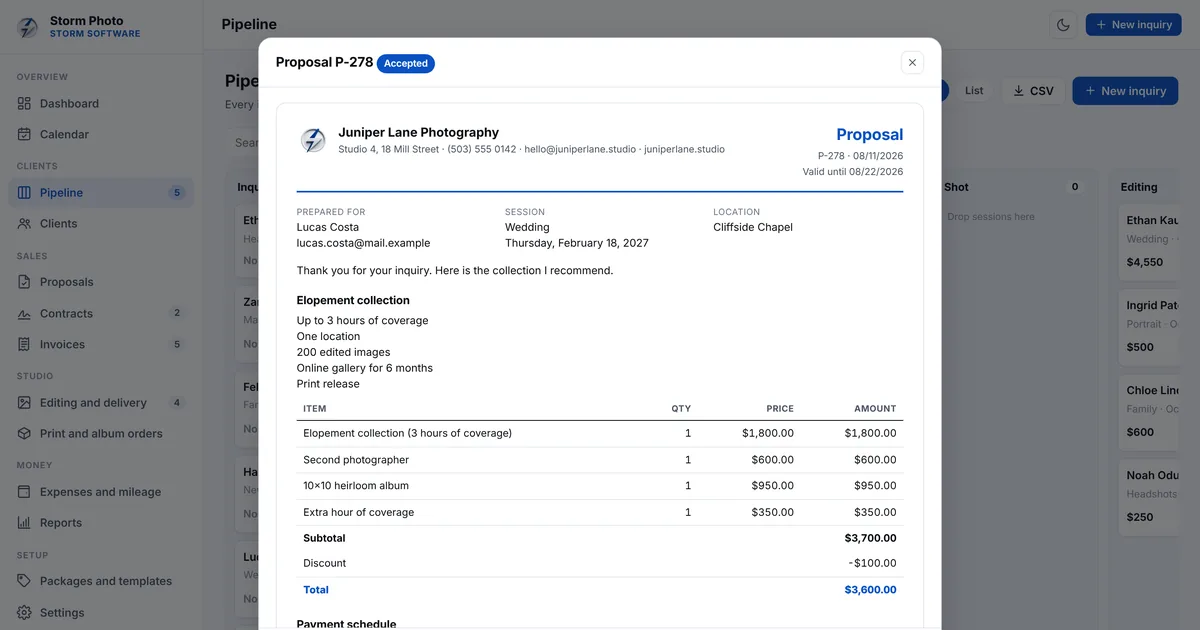
Storm Photo is a one-time alternative at $99. It runs offline in your browser on your own computer, with an inquiry pipeline, packages and add-ons, proposals that create the payment schedule and retainer invoice when accepted, contracts filled in from the booking, shoot plans, editing deadlines, print orders with lab costs and profit, and expense and mileage tracking. It does not have a client portal, online payments or sync between devices; data stays on the one device and you download backups yourself.
For general invoicing options, see our guide to invoicing software for small businesses.
See how Storm Photo runs inquiries, proposals, contracts and shoot planning for $99 once, with no monthly fees.
Frequently asked questions
How much should I charge for a photoshoot?
Work out your minimum hourly rate (yearly costs plus the income you want before tax, divided by your client work hours), multiply by the real hours the shoot takes including editing, and add the cost of any products. In our example that gives about $550 for a one-hour family session with 10 hours of total work.
What is the cost of doing business in photography?
It is everything your business needs to bring in over a year: the income you want before tax plus every business cost, from gear replacement and insurance to software, marketing and card fees. Dividing it by your work hours or sessions gives the least you can charge.
Should photographers charge hourly or by package?
Packages usually work better for portraits, families and weddings, because they include editing and delivery and are easier for clients to compare. Hourly or day rates are common for events and commercial work.
How much should a beginner photographer charge?
Enough to cover your cost of goods and travel at the very least, with a published end date for any introductory pricing. Move to your full cost of doing business price once your work is consistent; published ranges for portrait packages often start at $150 to $300.
How much of a retainer should a photographer take?
A set percentage you choose, often around 30%, taken at booking to secure the date, with the balance due before the shoot or before delivery. Put the amount, due dates and cancellation terms in your contract.
Sources
Try our free photography pricing calculator.
You may also like: Storm Contracts, Storm Books, Storm Salon