
How to Plan Your Day With ADHD: A Simple Method That Leaves Room to Breathe
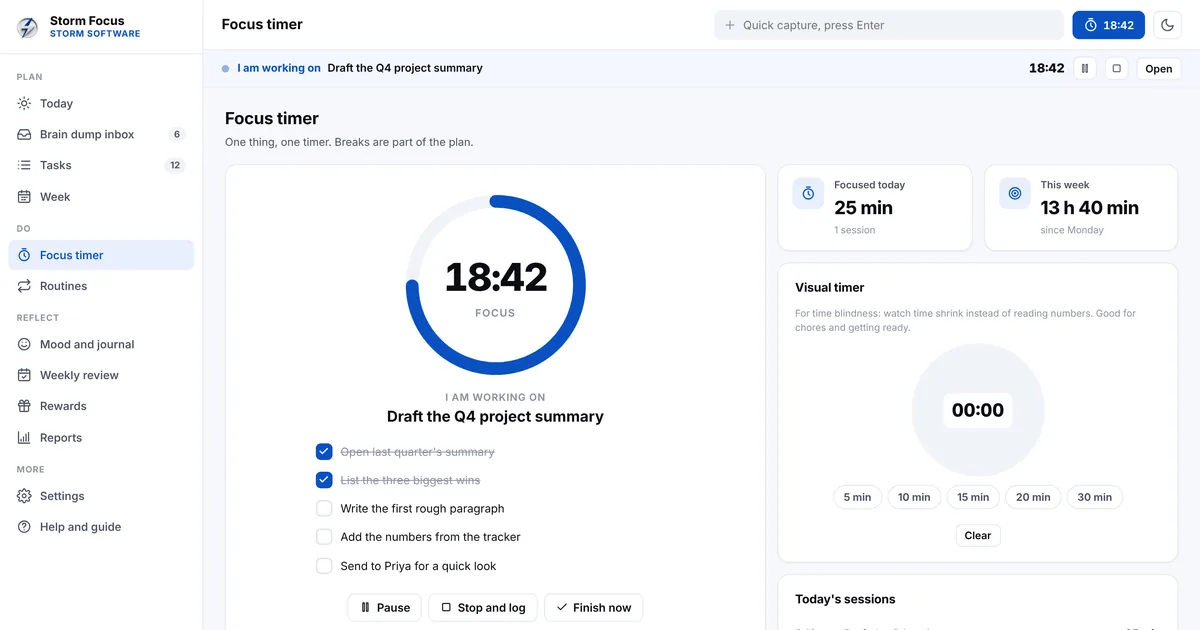
Many planning systems assume you can sit down, list everything and then follow the list for eight hours. If your brain does not work like that, those systems tend to end in a guilty, half empty notebook. This guide shares a lighter way to plan a day: get everything out of your head, choose a small number of things that matter, give them real time with room around them, and work in short blocks. It is a planning method, not medical advice, and it works for anyone who finds focus hard.
Start with a brain dump
Before you plan anything, write down everything that is taking up space in your head. Tasks, worries, ideas, errands, the email you keep forgetting. Do not sort it yet and do not judge it. The goal is to stop holding it in working memory.
Most people find the list is shorter than it felt. It also gives you something to choose from, instead of trying to plan from a blur.
Pick a top 3
From the brain dump, choose up to three things that would make today feel worthwhile. Not ten. Three is small enough to finish and big enough to matter.
A good top 3 usually mixes one important task, one quick win and one thing for you or your home. Everything else stays on the list for another day, and that is fine.
- One important task that moves something forward
- One quick win you can finish in under 20 minutes
- One thing for your health, home or people you care about
Break each one into a first tiny step
Big tasks are hard to start because the first step is unclear. Write the very first physical action for each of your top 3, the kind of step you could do in five minutes.
"Do taxes" becomes "find last year's tax folder". "Clean the kitchen" becomes "empty the dishwasher". Starting is often the hardest part, and a tiny step makes it easier.
Time block with buffers
Give each top 3 task a block on your day with a start time. Then add buffers. Tasks usually take longer than we expect, and switching between things takes time too.
A simple rule is to add about a third to every estimate and leave a 15 minute gap between blocks. If you finish early, the gap becomes a break. If you run over, nothing else falls apart.
A worked example day
Here is how a weekday might look for someone who starts at 9:00 and wants to stop at 17:30. Their top 3 are a client report, booking a dentist appointment and a 20 minute walk.
- 8:45 to 9:00: brain dump and pick the top 3
- 9:00 to 10:20: client report, three 25 minute focus rounds with short breaks
- 10:20 to 10:40: buffer, coffee and messages
- 10:40 to 10:55: quick win, call the dentist
- 11:00 to 12:30: meetings and smaller tasks from the list
- 12:30 to 13:15: lunch and the 20 minute walk
- 13:15 to 15:00: second block on the report, finish the draft
- 15:00 to 15:30: buffer and catch up
- 15:30 to 17:00: flexible time for anything urgent
- 17:00 to 17:30: wrap up, plan tomorrow's first step
Use our free Pomodoro timer for the focus rounds. It also shows how much of your day is left and how many rounds still fit.
Work in short focus rounds
Long stretches of work are hard to begin and hard to sustain. Short rounds with a clear end, such as 25 minutes of focus and a 5 minute break, make starting less daunting.
If 25 minutes feels too long, use 10 or 15. Pick one task before you start the timer, and use the break to move, drink water or check messages so they do not interrupt the next round.
Make time visible
Time can be hard to feel. A visible countdown, a clock in view or a note of how many hours are left in the day helps you notice time passing before it is gone.
Tracking how long tasks really take, against your guess, is useful too. After a week or two you will see a pattern, such as everything taking about 30 percent longer, and you can plan with that in mind.
Match tasks to your energy
Energy changes through the day. Put demanding tasks where you usually have the most energy and keep easy, low effort tasks for slumps.
A quick check in, low, some or full energy, can help you choose. On a low energy day, a smaller top 3 is still a good day.
Review gently at the end of the day
Spend five minutes looking at what you did, not only what you missed. Move unfinished tasks to another day or let them go, and write the first tiny step for tomorrow.
Once a week, a slightly longer review helps you notice wins, see what keeps slipping and choose next week's priorities.
Keep it all in one calm place
Paper works for many people, but brain dumps, timers, routines and reviews scattered across apps and notebooks are hard to keep up.
Storm Focus puts a brain dump inbox, your top 3, a time blocked day, a focus timer, routines, a weekly review and simple rewards in one offline app. Overdue tasks are surfaced gently, without walls of red, and your data stays on your own device. It is a planner, not medical advice.
See how Storm Focus helps you plan, focus and finish for $29 once, with no monthly fees.
The bottom line
Empty your head, pick a top 3, break each one into a tiny first step, give them time blocks with buffers, and work in short rounds. Plan for the day you actually have, not the perfect one, and be kind to yourself when it changes. If focus or attention is affecting your life a lot, a doctor or mental health professional can help, and a good plan works well alongside that support.
Try our free Pomodoro timer.
You may also like: Storm Habits, Storm Home, Storm Creator