
How to Make a Wedding Budget: A Simple Split That Works
Most wedding budgets go wrong in the same way: the first exciting booking uses up more than planned, and every decision after it feels squeezed. The fix is to decide the total and the split before you sign anything. This guide shows how to set a realistic number, divide it across categories, plan your deposits and keep track as quotes arrive.
Start with one total you are comfortable with
Before you look at venues, agree on the most you are willing to spend in total. Add up what you have saved, what you can save before the date, and any money family members have offered. Ask family early and get a clear amount, so you are not planning around a number that may change.
Try not to plan on borrowing. A wedding that starts married life with a large balance on a credit card is rarely worth it, and a smaller day you have paid for is far less stressful.
What weddings cost in the US
It helps to know where typical costs sit. According to The Knot 2025 Real Weddings Study, the average US wedding in 2024 cost about $33,000. The average venue was about $12,200, catering about $80 a plate, the photographer about $2,900, flowers about $2,700 and a DJ about $1,700.
Guest count makes a big difference. The same study put weddings with fewer than 50 guests at about $15,000 on average, and weddings with more than 100 guests at about $42,000. Prices also vary a lot by city and season, so treat these as a rough guide and use local quotes for your real plan.
Settle the guest list early
Guest count drives most of the cost. Every extra guest adds food, drinks, a seat, an invitation, a favor and often a bigger venue. Write a first guest list before you book a venue, and divide your total by that number to see your cost per guest.
If the cost per guest looks too high for the venues you like, you have two choices: a smaller list or a different style of day. It is much easier to make that choice now than after the deposits are paid.
Split the budget by category
Divide the total across categories before you book anything. A common starting split looks like this. Move a few percent toward what matters most to you, and away from what matters least, as long as the total stays at 100%.
- Venue and rentals: about 30%
- Catering, cake and drinks: about 30%
- Photography and video: about 10%
- Attire, hair and makeup: about 8%
- Flowers and decor: about 8%
- Music and entertainment: about 5%
- Stationery and postage: about 2%
- Transport, officiant, license, favors and gifts: about 3%
- Buffer for surprises: about 4%
Try your own numbers in our free wedding budget calculator. Enter your total and guest count, change any percentage, and add quotes as they come in to see where you are over or under.
Wondering why photography quotes vary so much? Here is how photographers price weddings.
A worked example
Say your total is $30,000 for 100 guests. That is $300 a guest. With the split above, the venue gets about $9,000, catering and drinks about $9,000, photography about $3,000, attire and beauty about $2,400, flowers about $2,400, music about $1,500 and stationery about $600, with $1,200 kept as a buffer.
Now the venue you love quotes $10,500. You can still book it, but the extra $1,500 has to come from somewhere. You might choose a smaller flower budget, a shorter photography package or fewer guests. Seeing the trade off in numbers makes the decision clear rather than stressful.
Keep a buffer for the costs nobody mentions
Quotes rarely include everything. Service charges, tax, gratuities, delivery and setup fees, overtime, alterations and last minute additions all add up. A buffer of a few percent stops these from pushing you over. If you do not use it, it becomes a nice start on the honeymoon.
Plan deposits and payment dates
Most vendors take a deposit to hold the date and the balance closer to the day. Write down every payment, how much it is and when it is due, so the money is ready and nothing is missed in the busy final weeks.
Read each contract for the cancellation terms and the date the balance is due. Some venues need final numbers and full payment weeks before the wedding.
Track every quote against the plan
As quotes come in, write them next to the planned amount for that category. When one comes in over, decide straight away where the difference will come from. Small overspends in several categories are how most budgets slip, because each one feels too small to matter.
Keep the whole plan in one place
Budgets work best next to everything else: the guest list, the vendors, the payment dates and the checklist. A spreadsheet can do it, but the guest list, seating and payments tend to end up in different files.
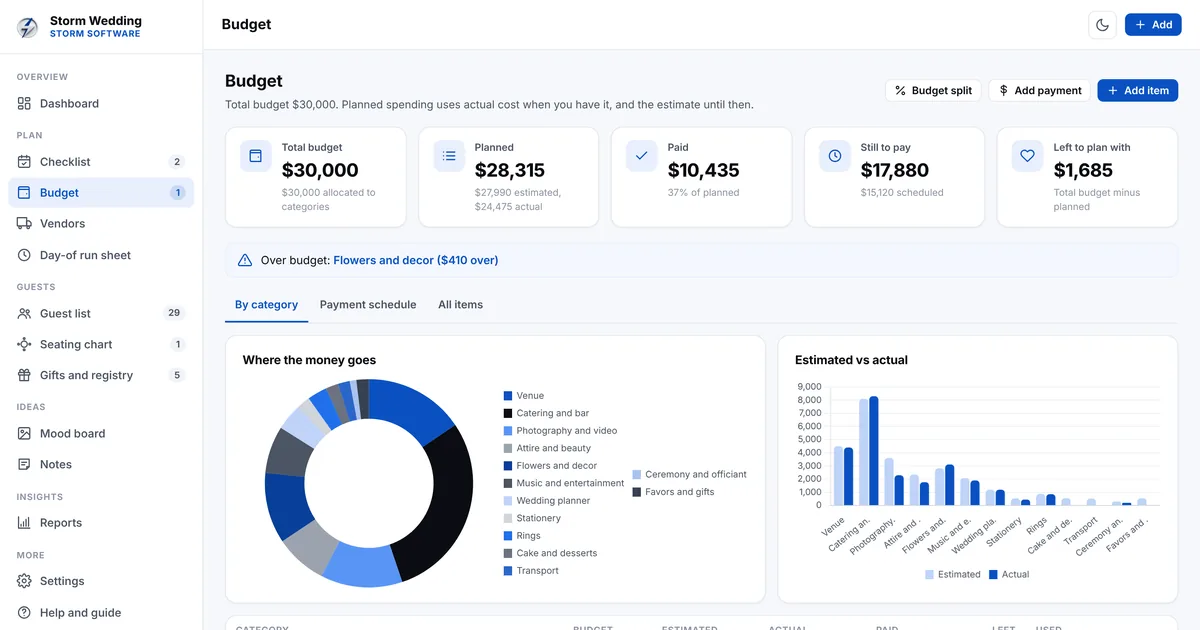
Storm Wedding keeps it together in one offline app. The budget has estimated and actual costs for every category, a payment schedule with deposits and balances, and alerts when a category goes over. It also handles the guest list and RSVPs, the seating chart, vendors, the checklist and the day-of run sheet.
See how Storm Wedding plans the whole day for $49 once, with no monthly fees and no ads.
For your everyday money after the wedding, read our guide to a budget app with no subscription.
Common budget mistakes
Booking the venue before setting a total is the most common one. Others are forgetting tax and service charges in catering quotes, underestimating the guest list, leaving out stationery and postage, and paying for small extras without checking the plan. Reviewing the budget once a month keeps it honest.
The bottom line
Agree on one total, settle the guest count, and split the money by category before you book anything. Keep a buffer, write down every payment date, and track each quote against the plan. Your wedding can be beautiful at almost any budget when the money goes to the things you care about most.
Try our free wedding budget calculator.
You may also like: Storm Photo, Storm Creator, Storm Teacher