
Debt Snowball vs Avalanche: Which Pays Off Debt Faster?
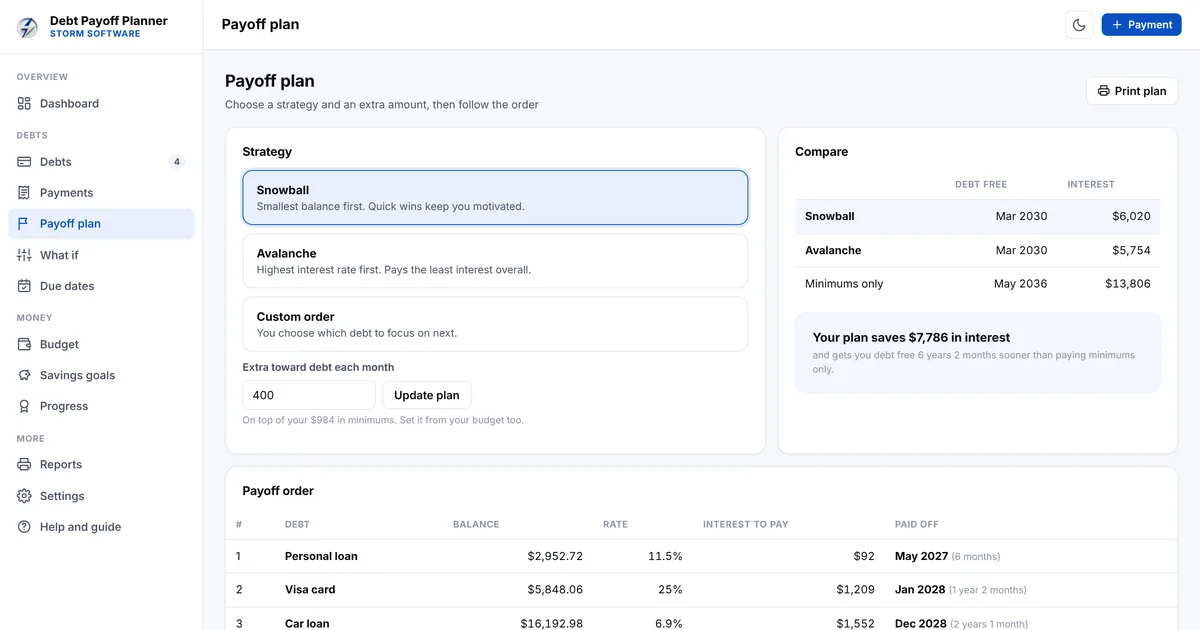
The debt snowball and the debt avalanche are the two most popular ways to pay off several debts. Both have you pay the minimum on every debt and put every spare dollar toward one target debt at a time. The only difference is which debt you target first. That one choice changes how much interest you pay and how motivated you feel along the way.
How the debt snowball works
With the snowball, you list your debts from the smallest balance to the largest, ignoring interest rates. You pay minimums on everything and throw all your extra money at the smallest balance. When it is paid off, its payment rolls into the next smallest. The payment grows like a snowball as each debt disappears.
The appeal is psychological. Clearing a whole debt in the first few months is a real win, and early wins keep people going.
How the debt avalanche works
With the avalanche, you list your debts from the highest interest rate to the lowest. Extra money goes to the most expensive debt first. Mathematically this always costs the least interest, because you are shrinking the balance that grows fastest.
The downside is that your highest rate debt might also be your biggest, so the first payoff can take a long time.
A worked example
Say you have three debts: a credit card with $6,500 at 21.5% (minimum $130), a car loan with $11,000 at 9.25% (minimum $395) and a store card with $1,200 at 18% (minimum $40). On top of the minimums you can pay $150 a month extra.
The snowball targets the $1,200 store card first and clears it in month 7, then moves to the credit card, then the car. The avalanche targets the 21.5% credit card first, so its first debt is not gone until month 31. Both plans finish in 32 months, and the avalanche saves about $80 in interest, roughly $3,790 against $3,870. In this case the maths barely separates them, but one plan gives you a win in month 7 and the other makes you wait more than two and a half years. The bigger difference is usually whether you keep going at all.
Which one should you choose?
If you are disciplined and motivated by numbers, choose the avalanche. If you have tried to pay off debt before and lost steam, choose the snowball. If your smallest debt also has a high rate, both methods agree and the choice is easy.
Some people use a hybrid: knock out one or two tiny balances for quick wins, then switch to the avalanche. That is perfectly sensible. Any plan you follow beats a perfect plan you abandon.
- Avalanche: least interest, best for steady, numbers-driven people
- Snowball: fastest first win, best if motivation is the problem
- Hybrid: clear the smallest one or two, then go by interest rate
Find extra money without starting from zero
The extra payment is what makes either method work. Even $50 to $150 a month can cut years off a payoff plan. The easiest sources are usually groceries and takeaway, unused subscriptions, and one-off money like tax refunds or bonuses. A simple budget makes these visible.
Our guide to budgeting without a subscription walks through setting one up in an afternoon.
Track it so you can see it working
Debt payoff is slow, and progress is hard to feel month to month. Seeing your debt-free date move closer after each payment helps a lot. A good debt payoff planner shows snowball and avalanche side by side, splits each payment into interest and principal, rolls paid-off payments into the next debt automatically, and lets you test what an extra payment or a lower rate would do before you commit.
Storm Debt Planner does all of this offline for $39 once. See the debt payoff planner for details.
What to do with a payoff that frees up money
When a debt is paid off, it is tempting to spend the freed-up payment. Resist it. Rolling that payment into the next debt is what makes both methods accelerate. Once all debts are gone, keep the habit: redirect the same total monthly amount into an emergency fund, then into savings goals. You were already living without that money, so it will not feel like a sacrifice.
Common questions
Should I build savings before paying off debt? Most people benefit from a small starter emergency fund first, so a surprise expense does not go straight back on a credit card.
What about a 0% balance transfer? It can save a lot of interest, but only if you clear the balance before the promotional rate ends. Treat it as a tool for the avalanche, not as extra room to spend.
Does the order matter if all my rates are similar? Barely. If your rates are close, the snowball's quick wins usually make it the better choice.
The bottom line
The avalanche wins on paper. The snowball often wins in real life. Pick the one that matches how you stay motivated, find a regular extra payment, and track your progress so you can see your debt-free date getting closer. This is general information, not financial advice; if you are struggling with repayments, talk to a qualified adviser or your lender.
You may also like: Storm Budget, Storm Meal Planner, Storm Rentals