
Sales Tax, VAT and GST: A Plain Guide for Small Businesses
Most small businesses collect tax on what they sell long before they feel confident about how it works. Whether your tax authority calls it sales tax, VAT or GST, the job is the same: charge the right amount, keep it separate from your own money, and hand it over on time with a return that adds up. This guide explains the differences in plain language, shows how to add and remove tax correctly, and covers the records that make filing quick.
What sales tax, VAT and GST have in common
All three are taxes on spending that a business collects from its customers on behalf of the government. You add the tax to your price, the customer pays it, and you pass it on to the tax authority with a return for each filing period. The money was never yours, which is why it pays to treat it that way from the day you receive it.
The names change from country to country. The United States uses sales tax, set by states and local governments rather than nationally. The UK and the European Union use value added tax, or VAT. Canada, Australia, New Zealand and India use goods and services tax, or GST, and some Canadian provinces combine it with a provincial tax as HST.
The big difference: claiming tax back
US sales tax is generally charged once, on the final sale to the end customer. A business buying supplies for its own use usually pays sales tax on them like anyone else and can't reclaim it, although goods bought for resale are often exempt with a resale certificate.
VAT and GST are charged at every step of the supply chain. A registered business charges tax on its sales, pays tax on its purchases, and on each return pays only the difference. If you collected 3,000 of VAT in a quarter and paid 1,100 of VAT on business costs, you owe 1,900. If you paid more than you collected, the tax authority owes you a refund.
That single difference changes how you record costs. Under VAT or GST, the tax on a bill is kept separate so you can claim it. Under US sales tax, the tax you pay is simply part of the cost of the item.
- Sales tax: collected on sales, usually not reclaimed on your own costs
- VAT and GST: collected on sales and reclaimed on business purchases
- Both: reported and paid for each filing period
Adding tax to a price
To add tax, multiply the net price by the rate and add the result. At 20%, a net price of 250 has 50 of tax and a gross price of 300. The shortcut is gross equals net multiplied by one plus the rate, so 250 x 1.2 = 300.
When an invoice has several lines, you can round the tax on each line or once on the total. The two methods can differ by a cent. Either is normally fine as long as you are consistent, but some tax authorities state a preference, so check theirs.
Removing tax from a total
When you have a receipt that includes tax, divide the total by one plus the rate to find the net amount. A receipt for 300 at 20% VAT is 300 / 1.2 = 250 net, so the VAT is 50.
The most common mistake is to take the rate straight off the gross. Twenty percent of 300 is 60, which would make the net 240 and overstate the tax you can claim. Over a year of receipts, that error adds up and is exactly the kind of thing a tax inspector looks for.
Try both directions with any rate in our free sales tax and VAT calculator. It handles several lines at once and shows the net, the tax and the gross for each.
When you need to register
Most countries only require registration once your sales pass a threshold, and the threshold is set by each tax authority and changes from time to time. In the US, each state decides when an out of state seller has to collect its sales tax, often based on the value of sales into that state each year. In VAT and GST countries, the threshold is usually based on your taxable turnover over the last 12 months.
Some businesses register voluntarily below the threshold so they can claim back tax on their costs. That can make sense if most of your customers are businesses that can reclaim the tax you charge them. Check the current rules on your tax authority's website or with an accountant before you decide.
Filing periods and the records to keep
Returns are usually due monthly, quarterly or yearly, depending on your size and where you are. Every return asks the same basic questions: how much did you sell, how much tax did you collect and, for VAT and GST, how much tax did you pay on purchases. If your records are in order, the return is a short job.
- A copy of every invoice you issued, with the tax shown separately
- Every bill and receipt for business costs, ideally with a photo
- Credit notes and refunds, which reduce the tax you owe
- The tax rate used on each line, especially if you sell at more than one rate
- A record of each return you filed and each payment you made
- A separate note of any tax you can't reclaim, such as on certain entertainment costs
Common mistakes to avoid
Spending the tax is the biggest one. Tax collected sits in your bank account alongside everything else, and it is easy to treat it as income. Many owners move it to a separate savings account each week so the money is there when the return is due.
Other mistakes are quieter: charging the wrong rate on a product that has a reduced rate, claiming tax on a receipt that doesn't show it, forgetting to include credit notes, and filing a return that doesn't match the bank account. Reconciling your bank account before each return catches most of these.
Keeping track without a spreadsheet
A spreadsheet works until the first period where the numbers don't agree. Accounting software that works out tax on every invoice, bill and expense, and reports it by filing period, removes most of the arithmetic and keeps an audit trail of where each figure came from.
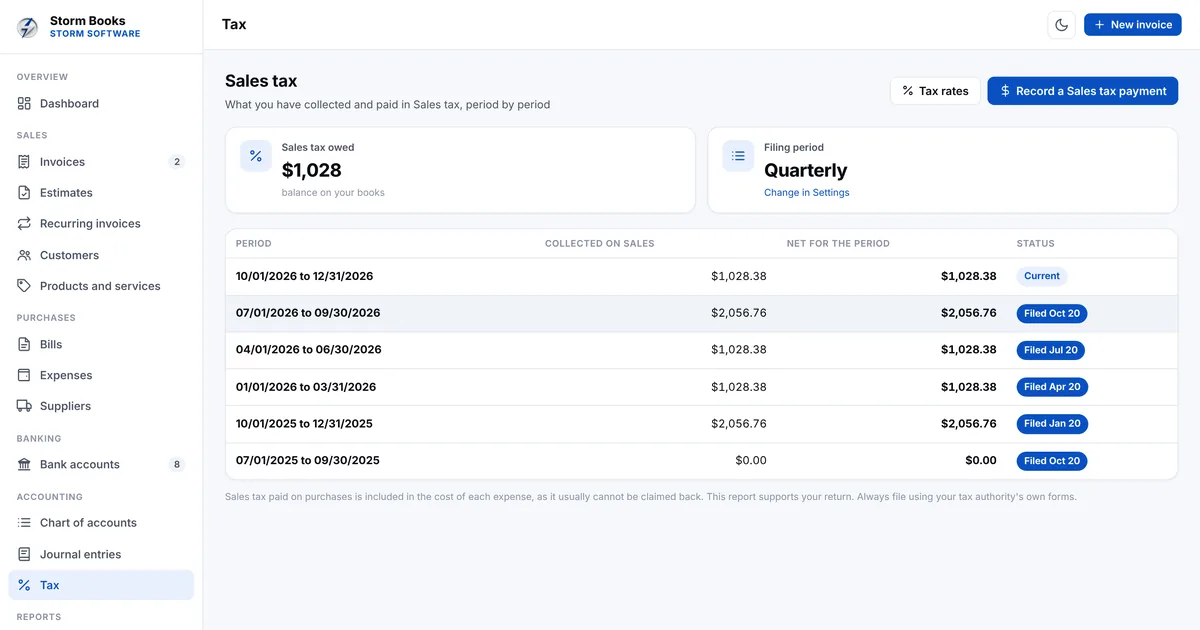
Storm Books does this offline, on your own computer. It is set up for US sales tax and for VAT and GST in the UK, Europe, Canada, Australia and New Zealand, and you can add your own rates. Each filing period has a tax report showing tax collected and tax paid, and you can record the payment and mark the period as filed.
See how Storm Books handles invoices, bills, bank reconciliation and tax for $199 once, with no monthly fees.
For more on getting paid, read our guide to invoicing software for small businesses.
The bottom line
Sales tax, VAT and GST all come down to charging the right rate, keeping the tax separate and filing on time. Add tax by multiplying, remove it by dividing, keep every invoice and receipt, and reconcile before you file. This guide is general information, not tax advice, so confirm the rules that apply to you with your tax authority or an accountant.
Try our free sales tax and VAT calculator.
You may also like: Storm Contracts, Storm Rentals, Storm Restaurant POS