
How to Price Lawn Mowing and Landscaping Jobs
Lawn care looks simple to price until the season gets busy. A yard that takes twice as long as you guessed, a mulch job that eats your margin, or a route full of small lawns that barely cover the drive time can quietly turn a full schedule into a poor year. This guide covers the common ways to price lawn mowing and landscaping work, how to handle materials, and how to check that every job actually pays.
Three ways to price lawn care
Most lawn care businesses use one of three methods, or a mix depending on the service.
- Per visit: a flat price for each mow, based on the lawn and any obstacles. Easy for customers to understand and quick to quote.
- By area: a rate per thousand square feet or per square metre. Fair for very large or very small lawns and easy to apply consistently.
- By the hour: common for cleanups, hedge trimming and landscaping where the work is hard to measure in advance.
Pricing mowing
Start with the lawn area. Measure it once, from the property or from satellite images, and save it so every future quote uses the same number. Then adjust for what slows you down: steep slopes, lots of beds and trees to trim around, gates that are too narrow for the big mower, and how far the clippings have to travel.
Set a minimum charge per visit. Small lawns still need travel, unloading and setup time, and a minimum stops them from losing money. Many businesses also charge more for the first cut of the season or for overgrown lawns.
Pricing materials
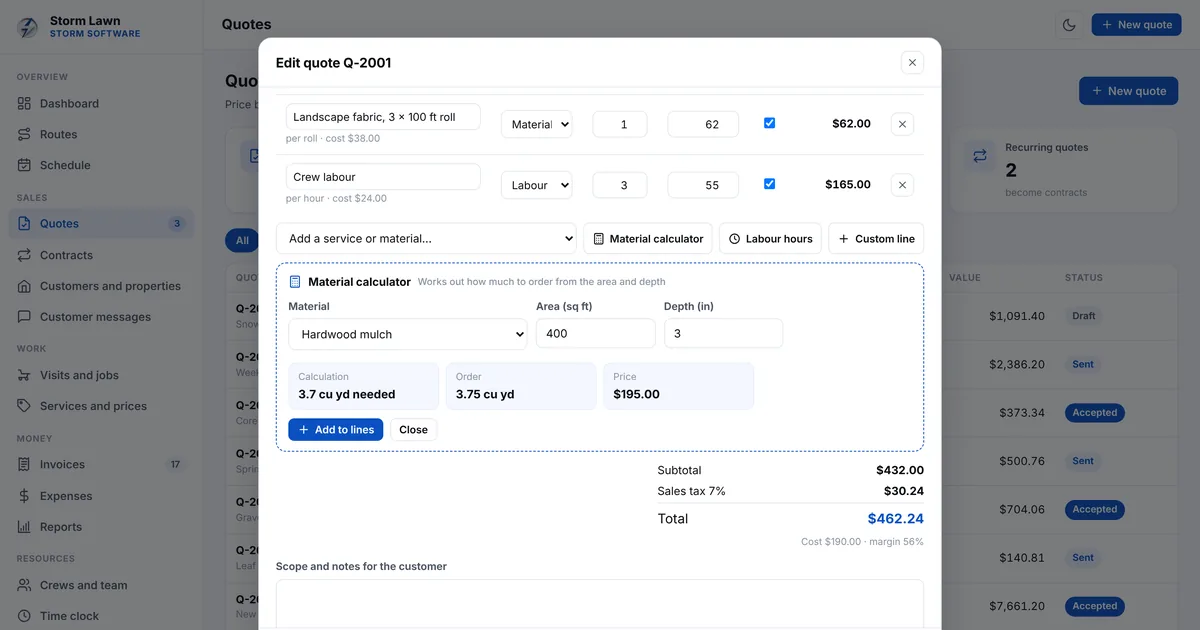
Mulch, soil, gravel and sod are priced by volume or area, so measure every bed and work out exactly what you need. For mulch, area in square feet times depth in feet gives cubic feet, and dividing by 27 gives cubic yards.
Price materials at your cost plus a markup that covers collection, waste and the trips to the supplier. Then add labour for spreading, edging and cleanup as a separate line. Quoting the material and labour separately makes the price easier to explain and harder to undercut on materials alone.
Work out volumes, bags and costs with our free mulch calculator. It also covers topsoil, gravel by weight and sod.
Cleanups, aeration and extra services
Spring and autumn cleanups, aeration, dethatching, fertiliser programs, hedge trimming and leaf removal are where many lawn businesses earn their best margins. They are usually priced by the hour or by the job, with a minimum charge.
Quote cleanups after seeing the property, or from clear photos, because the volume of leaves and debris varies so much. For fertiliser programs, price per application by lawn area and sell the program as a set of visits, so it can be added to the same seasonal contract as mowing.
Offer these services to existing mowing customers first. They already trust you, you are already on site, and adding a service to an existing visit costs far less than winning a new customer.
Seasonal contracts
Seasonal contracts are where steady lawn care income comes from. Instead of quoting each visit, you agree a set of visits for the season, such as weekly mowing from spring to autumn, and bill per visit, monthly or upfront.
Monthly billing spreads income evenly and is easy for customers to budget. Upfront billing can include a small discount in exchange for cash early in the season. Either way, write down what happens with rain delays, skipped visits and the end date, so there are no arguments in late summer.
Know your cost per hour
Every price should be checked against what an hour of your crew's time really costs. Add wages, fuel, equipment wear and maintenance, insurance, vehicle costs and the admin you do in the evenings, then divide by the hours you actually spend on lawns.
Once you know that number, check each job. If a weekly lawn takes 45 minutes including travel but pays less than three quarters of your hourly cost, either the price needs to rise or the lawn needs to move to a route where it is quicker to reach.
- Record actual time on each property for a few weeks
- Include drive time between stops, not just time on the lawn
- Review prices before each season, not halfway through
For a full worked example of the cost of doing business method, see how to price photography.
Routes change your profit
Two identical lawns can have very different profits depending on where they sit on your route. Grouping customers by area, visiting them in a sensible order and keeping drive times short adds paid hours to every day.
When you quote a new customer far from your existing routes, include the extra travel or decline politely. A full schedule spread across a wide area can earn less than a smaller, tight one.
Quoting and scheduling without the spreadsheet
Consistent pricing is much easier when lawn and bed sizes are saved for every property and the same rates apply to every quote. Storm Lawn prices quotes by lawn area, bed area or hedge length, calculates materials, books seasonal contracts that create every visit, and plans crew routes with drive times. It works offline on your own computer for a one-time price.
See how Storm Lawn handles quotes, seasonal contracts and crew routes for $149 once, with no monthly fees.
For getting paid on time, read our guide to invoicing software for small businesses.
The bottom line
Price mowing per visit or by area with a minimum charge, price materials at cost plus a markup with labour on top, and sell seasonal contracts for steady income. Then check every job against your real cost per hour, including the drive. Clear, consistent pricing keeps the schedule full and the business profitable.
Try our free mulch calculator.
You may also like: Storm Clean, Storm Electrical, Storm Books