
How to Calculate Etsy Fees and Price Your Products for Profit
Many Etsy sellers know their item price and their material costs, but not what Etsy actually takes from each sale. The fees are small one by one, yet together they often take 10% to 15% of what the buyer pays, and much more when a sale comes from an offsite ad. This guide explains each fee, walks through a real example and shows how to work backwards to a price that protects your profit.
The fees on a typical sale
Most Etsy sales carry three fees: a listing fee, a transaction fee and a payment processing fee. Some sales also carry an offsite ads fee, and depending on where your shop is based you may see a regulatory operating fee and VAT or GST charged on your seller fees.
Etsy updates its fees from time to time and some depend on your country, so treat the rates below as typical and check them against the Fees and Payments policy and your own Payment account.
- Listing fee: 0.20 US dollars per listing, charged again each time an item sells and the listing renews
- Transaction fee: 6.5% of the item price plus the shipping and gift wrap you charge
- Payment processing: in the US, 3% of the order total plus 0.25 dollars. Other countries use different rates
- Offsite ads: 15% of the order, or 12% for shops with more than 10,000 dollars in yearly sales, capped per order
- Regulatory operating fee and VAT or GST on fees in some countries
A worked example
Say you sell a candle for 28 dollars and charge 5.95 for shipping, so the buyer pays 33.95. The candle costs 6.50 to make and the shipping label costs 4.80. The sale did not come from an offsite ad and your shop is in the US.
The listing fee is 0.20. The transaction fee is 6.5% of 33.95, which is 2.21. Payment processing is 3% of 33.95 plus 0.25, which is 1.27. Together Etsy takes 3.68, or about 10.8% of the sale.
From the 33.95, take away 3.68 in fees, 6.50 to make the candle and 4.80 for the label. You keep 18.97 in profit, a margin of about 56%. That is a healthy sale, but the picture changes fast with cheaper items or offsite ads.
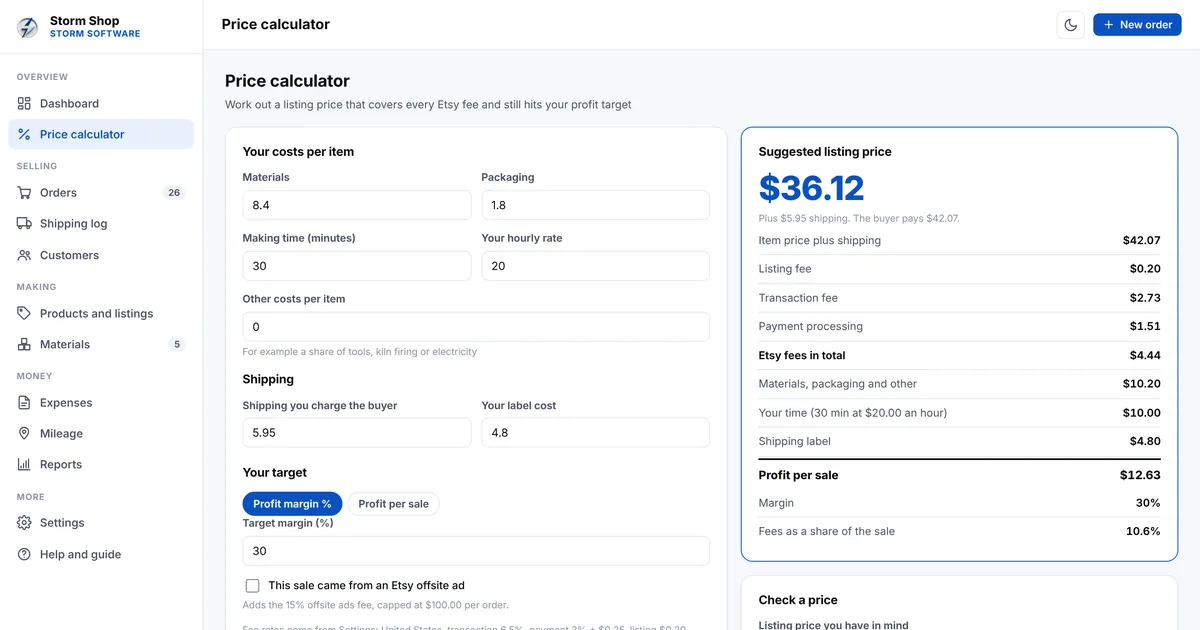
Run your own numbers in our free Etsy fee calculator. It shows each fee, your profit and margin, and the price you need for the margin you want, with presets for the US, UK, Canada, Australia and Europe.
Why shipping does not escape the fees
Some sellers lower the item price and raise shipping to make the item look cheaper. The transaction fee and payment processing fee are both charged on the shipping amount too, so this does not reduce your fees. It only moves the money around, and buyers often filter by free or low shipping anyway.
If you offer free shipping, build the label cost into the item price and check that the new price still covers your fees and costs.
How offsite ads change the math
When a shopper clicks an Etsy ad on another site and buys within 30 days, the offsite ads fee applies on top of everything else. On the candle above, a 15% fee adds about 5.09, and fees jump from roughly 11% to roughly 26% of the sale.
If your margins are thin, an offsite ad sale can leave you with very little. Know your numbers for both cases, and price so that even an ad sale is still worth making.
Price backwards from the margin you want
Instead of guessing a price and checking the profit, start from the margin you want and work backwards. Add up your cost to make the item, your label cost and the fixed fees. Then divide by what is left of each dollar after the percentage fees and your target margin.
With the US rates above, the percentage fees come to 9.5% of the sale. For a 35% margin, 55.5% of each dollar the buyer pays has to cover costs and fixed fees. On the candle, that gives a minimum item price of about 15.22 dollars before you think about what the market will pay.
- Cost to make the item, including materials, packaging and your time
- Shipping label cost, or the shipping you absorb
- Fixed fees: the listing fee and the payment processing fixed fee
- Percentage fees: transaction, payment processing and any offsite ads
Count your time and materials honestly
Fees are only part of the cost. Many handmade sellers underprice because they leave out their own time, packaging, or the true cost of materials bought in bulk. A bill of materials for each product, with a unit cost for every material and a labour rate for the minutes you spend, gives you the real cost to make.
Once you know it, the fee math above tells you the lowest price that still works, and the market tells you how far above it you can go.
Track fees across every order
One worked example is useful. Knowing your fees and profit across every order, every product and every month is what tells you whether the shop is really making money. Doing that by hand in a spreadsheet takes hours, and most sellers stop after a few weeks.
Storm Shop does it in one offline app. Import your Etsy orders CSV, and each order shows its listing, transaction, processing and offsite ads fees, your material and label costs, and your profit. The price calculator sets prices for your target margin, and the monthly profit and loss breaks down every fee type.
Once your prices are right, work out when to reorder materials so you never run out mid-month.
See how Storm Shop tracks fees, pricing, orders, materials and profit for $59 once, with no monthly fees. Storm Shop is not affiliated with Etsy.
If you collect sales tax or VAT, read our sales tax, VAT and GST guide.
Common mistakes
Forgetting that the listing fee is charged again on every sale. Leaving shipping out of the fee math. Pricing for normal sales and being caught out by offsite ads. Ignoring VAT or GST on fees outside the US. And not checking your real fees on your Payment account every few months, since rates do change.
The bottom line
Add up every fee on a sale, including shipping and any offsite ads, then subtract your real cost to make and ship. Price backwards from the margin you want, and check your numbers across all your orders, not just one example.
Try our free Etsy fee calculator.
You may also like: Storm Stock, Storm Books, Storm Photo