
How to Calculate a Reorder Point and Safety Stock
Running out of a best seller costs sales and customers. Holding too much stock ties up cash and shelf space. The reorder point is the simple number that sits between the two: when stock falls to it, you order. This guide shows how to calculate it, how to choose a sensible safety buffer, and how to decide how many units to buy each time.
The reorder point formula
The reorder point is the stock you expect to sell while waiting for a delivery, plus a safety buffer. Written as a formula, it is reorder point equals average daily sales times lead time in days, plus safety stock.
Lead time is the number of days from placing an order to having the stock on the shelf, not just the shipping time. Include the time it takes the supplier to process the order and the time you need to receive and put it away.
Step one: lead time demand
Start with your average daily sales for the item. Use a recent period long enough to be meaningful, such as the last 60 to 90 days, and divide units sold by the number of days.
If you sell an average of 12 units a day and your supplier usually takes 7 days to deliver, you will sell about 84 units while you wait. If you reorder at exactly 84, you only avoid running out when everything goes to plan.
Step two: safety stock, the simple way
The max minus average method plans for a bad week. Multiply your highest daily sales by your longest lead time, then subtract your average daily sales times your average lead time.
With a highest day of 20 units and a longest lead time of 10 days, the worst case is 200 units. The normal case is 84, so safety stock is 116 and the reorder point is 200. This method is easy to explain and rarely runs out, but it can hold more stock than you need, especially for items with one unusual spike in their history.
Step three: safety stock by service level
The service level method sets the buffer from how much your daily sales actually vary. You need the standard deviation of daily sales, which a spreadsheet can calculate from a column of daily totals, and a target service level.
Safety stock equals a service factor times the standard deviation times the square root of the lead time. Common factors are about 1.28 for 90%, 1.65 for 95% and 2.33 for 99%. With a standard deviation of 4 units and a 7 day lead time, a 95% target gives 1.65 times 4 times 2.65, or about 18 units, for a reorder point of 102.
A 95% service level means you expect to have stock through about 95 of every 100 reorder cycles. Higher targets cost more stock for each extra point, so save 98% or 99% for items where running out is expensive.
Work through both methods with your own numbers in our free reorder point calculator. It also works out how many units to order.
How much to order: economic order quantity
The reorder point tells you when to order. The economic order quantity, or EOQ, suggests how many. It balances the cost of placing an order, such as admin and delivery fees, against the cost of holding stock, such as storage, insurance and the cash tied up.
EOQ is the square root of 2 times yearly demand times the cost per order, divided by the yearly holding cost per unit. Selling 4,380 units a year, with 50 per order and a holding cost of 2.50 per unit per year, gives an EOQ of about 419 units. Treat this as a guide and round it to case sizes, minimum orders and price breaks.
Worked example from start to finish
Here is the whole process for one product. Average daily sales are 12 units, the highest day in the last quarter was 20, the usual lead time is 7 days and the longest was 10. Lead time demand is 84 units.
Using the max minus average method, safety stock is 116 and the reorder point is 200. Using a 95% service level with a standard deviation of 4, safety stock is 18 and the reorder point is 102. The difference shows why the method matters: the simple method holds almost 100 extra units, worth about 1,000 at a unit cost of 10.
If you have 150 units on hand, the service level method says you have about four days before you need to order, while the cautious method says order now. Pick the method that matches how reliable your supplier is and how costly a stockout would be.
Common mistakes
Most reorder problems come from stale or incomplete numbers rather than the formula itself.
- Using sales from a different season without adjusting
- Ignoring supplier processing time and only counting shipping
- Setting one rule for every product instead of item by item
- Forgetting stock that is already on order when deciding to reorder
- Never recalculating as sales grow or suppliers change
Making reorder points part of your routine
Reorder points only help if you check stock against them regularly. With a handful of products a spreadsheet works. With hundreds of items and variants across several locations, it quickly becomes a weekly chore that gets skipped.
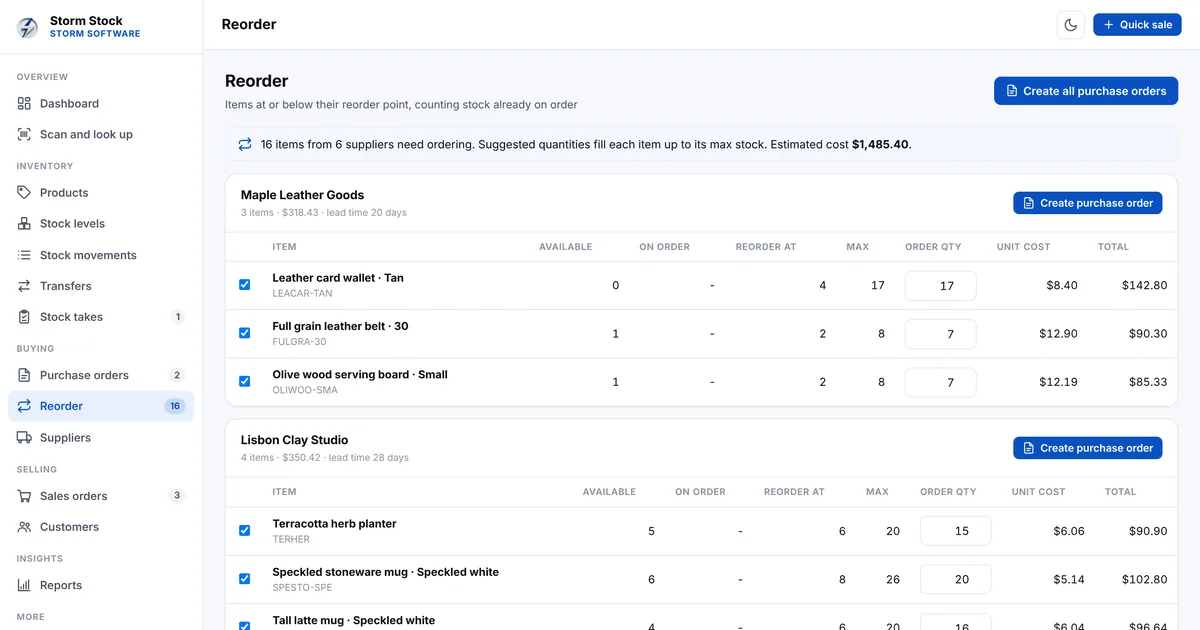
Storm Stock tracks every movement of stock, keeps a reorder point for every product and variant, and builds a suggested reorder list grouped by supplier that turns into purchase orders in one click. It works offline on your own computer for a one-time price.
See how Storm Stock handles reorder points, purchase orders and barcodes for $149 once, with no monthly fees.
If you sell across borders, our guide to sales tax, VAT and GST covers pricing with tax.
The bottom line
Reorder when stock falls to your lead time demand plus safety stock. Use the max minus average method for a simple, cautious buffer, or the service level method when you have good sales data. Order sensible quantities, and recalculate every few months so the numbers keep up with your business.
Try our free reorder point calculator.
You may also like: Storm Books, Storm Restaurant POS, Storm Mechanics