
How Long Does It Take to Form a Habit? What the Research Actually Says
You have probably heard that it takes 21 days to form a habit. It is a tidy number, but the research does not back it up. The best known study found that a new daily habit took a median of about two months to feel automatic, and the range ran from under three weeks to most of a year. This guide explains what the research found, why the spread is so wide, and how to use that to set honest expectations for your own habits.
Where the 21 day idea came from
The 21 day figure is usually traced to a plastic surgeon in the 1960s who noticed his patients took about three weeks to get used to a new appearance. He wrote that it took a minimum of about 21 days for an old mental image to fade.
Over the years, minimum became exactly, and a change in self image became any habit at all. It makes a catchy promise, but it was never a study of habit formation.
What the research found
In 2010 Phillippa Lally and colleagues at University College London asked 96 volunteers to pick a new eating, drinking or activity behaviour and do it once a day in the same situation, such as after breakfast. Each day they rated how automatic it felt.
The median time to reach their plateau of automaticity was 66 days. The fastest took 18 days and the slowest were projected to need 254 days. Simple behaviours like drinking a glass of water reached the plateau sooner than harder ones like doing sit ups.
You can read the original paper, Lally et al. (2010) in the European Journal of Social Psychology.
Newer research tells a similar story
A 2024 systematic review led by researchers at the University of South Australia pooled 20 studies with more than 2,600 people. It found median times of about 59 to 66 days for health habits to form, with individual times ranging from 4 days to 335 days.
The exact numbers differ between studies, but the message is consistent. Most habits take around two months, and some take much longer.
The University of South Australia summary of the 2024 review explains the findings in plain language.
Why the range is so wide
Habits form through repetition in a stable setting, so anything that changes how often and how consistently you repeat a behaviour changes the timeline.
- How hard the habit is: one glass of water is easier to make automatic than a 30 minute workout
- How often you do it: daily repetition builds a habit faster than three times a week
- How stable the cue is: the same time and place, or straight after an existing routine, helps a lot
- How much you enjoy it: rewarding habits tend to stick sooner
- You as a person: some people simply take longer, and that is normal
A worked example
Say you start reading 10 pages a night on October 17 and you manage five nights a week. For a medium habit the typical figure is about 66 practice days. At five days a week that takes about 93 calendar days. You have also missed two planned nights, which pushes it back two more days, so a realistic estimate is around January 20.
The honest range is wider. If it turns out easier than you expect it could feel automatic by mid December, and if it is harder it could take until April. Knowing that up front makes it much easier to keep going in week five, when the novelty has worn off but the habit has not yet settled.
Run your own dates in our free habit formation calculator. Pick how hard the habit is and how often you practise, and it gives you a typical date and a range.
Does missing a day ruin it?
No. One of the most useful findings in the Lally study is that missing a single day did not materially affect how quickly the habit formed. What matters is getting back to it.
This is why rigid all or nothing streaks can backfire. If one missed day makes you feel you have failed, you are more likely to give up altogether. A better rule is never to miss twice in a row, and to plan for sick days and travel rather than pretending they will not happen.
How to make a habit stick sooner
You cannot skip the repetitions, but you can make each one easier and more consistent.
- Tie it to a cue you already have, such as after you pour your morning coffee
- Start smaller than feels useful, then grow it once it is automatic
- Do it at the same time and in the same place
- Make it easy to start and remove friction, like laying out your shoes the night before
- Track it so you can see your progress and spot patterns
- Plan what you will do on hard days so a slip does not become a stop
Track it without losing your streak
Seeing your progress is one of the simplest ways to keep a habit going through the slow middle weeks. A tracker that punishes one missed day can do more harm than good, though.
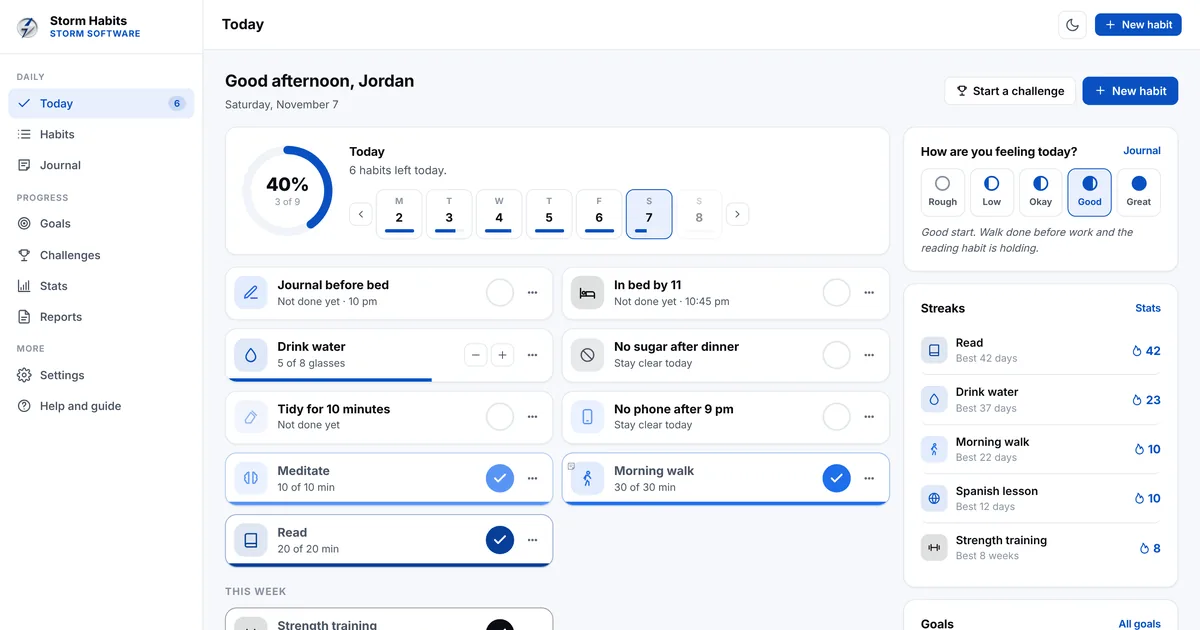
Storm Habits lets you check off habits in one tap, use skip days that keep a streak alive on a sick day or a trip, and see every habit on a year heatmap. Goals show your pace and an estimated finish date, and everything stays offline on your own device.
See how Storm Habits tracks habits, streaks and goals for $19 once, with no subscription.
The bottom line
It usually takes about two months for a new habit to feel automatic, not 21 days, and it can take a lot longer for harder habits. Expect a range rather than a fixed date, repeat the habit in the same setting as often as you can, and do not let a missed day talk you out of it. Slow, steady repetition is what does the work.
Try our free habit formation calculator.
You may also like: Storm Focus, Storm Home, Storm Coach