
Commission vs Booth Rent: How to Pay Salon Stylists
Few decisions shape a salon more than how stylists are paid. Commission and booth rent are the two main models, and each suits a different stage of a stylist's career and a different kind of salon. This guide explains how both work, the details that quietly change the numbers, and how to compare them fairly before you sign or offer an agreement.
How commission works
On commission, the stylist is usually an employee or works under the salon's brand. The salon sets the prices, books the clients, supplies the products and handles the front desk, and pays the stylist a percentage of the service revenue they bring in.
Commission suits newer stylists who are still building a client list. Walk-ins, the salon's marketing and its reputation fill the book, and the stylist does not carry the risk of a slow week. The salon, in return, keeps a large share of each sale to cover rent, wages, products, software and profit.
How booth rent works
A booth renter runs their own small business inside the salon. They pay a fixed weekly or monthly rent for a chair or room, then keep all of their service income. In most places they also set their own prices, keep their own schedule, buy their own products and handle their own taxes and insurance.
Booth rent suits established stylists with a full book and loyal clients. Every client above the break even point is profit for the stylist. The salon gets steady rent with less management, but less control over prices, hours and the client experience.
The details that change the numbers
Two offers with the same headline rate can pay very differently. Before comparing, look at the whole deal.
- Product charge: many salons take a small percentage off service sales before commission to cover colour and back bar products
- Tiered rates: a higher percentage above a sales threshold rewards busier stylists
- Retail commission: usually lower than service commission because product margins are smaller
- Tips: normally go to the stylist in full under both models
- Booth rent extras: some salons add fees for laundry, utilities or booking software on top of rent
- Own products: booth renters pay for their own colour and supplies, which can be a large weekly cost
Flat versus tiered commission
A flat rate pays the same percentage on every sale and is easy to understand. A tiered rate pays one percentage up to a threshold and a higher one above it.
Tiers work best when they are paid like tax brackets, where the higher rate only applies to the sales above the threshold. If the whole week jumps to the higher rate once a line is crossed, stylists can earn less on a busy week than a quieter one, and the system creates arguments at the end of each pay period.
Comparing the two with real numbers
Take a stylist with 3,000 in weekly service sales, 300 in retail and 400 in tips. On a flat 45% commission with a 5% product charge, service commission is 45% of 2,850, which is 1,282.50. Add 10% retail commission and tips, and the week pays 1,712.50.
Renting a booth at 250 a week and spending 150 on products, the same stylist keeps 3,000 after rent and products, including tips. At that level of sales booth rent pays clearly more. At 1,200 in weekly sales the gap shrinks fast, and in a quiet week the renter still owes the full rent.
Try your own numbers in our free salon commission calculator. It handles flat and tiered rates, product charges, retail, tips and a booth rent comparison.
Questions to ask before you choose
Whether you are a stylist weighing an offer or an owner writing one, a few questions make the comparison honest. The answers often matter more than the headline percentage.
- How many clients does the stylist bring with them, and how many would the salon supply?
- What are typical weekly sales in a slow month, not just a busy one?
- Who pays for colour, back bar products and towels?
- Who sets prices and who keeps the client contact details?
- What notice is needed to leave, and what happens to booked appointments?
- How are tips, gift cards and prepaid packages handled when they are redeemed?
What salon owners should think about
For an owner, commission gives control over pricing, service standards and the client relationship, which protects the salon's brand. It also means payroll, scheduling and the cost of quiet periods.
Booth rent gives predictable income with less admin, but the salon depends on renters staying. Clients often follow a renter who leaves, so the client list is not really the salon's. Many salons run a mix, with commissioned junior stylists and a few senior renters.
Whichever model you choose, write it down. A clear agreement covering rates, product charges, tips, notice periods and who owns the client records prevents most disputes.
Keeping commission accurate
Commission only works if every sale is recorded against the right stylist, with tips and retail separated. A spreadsheet at the end of each week invites mistakes, especially with split payments, gift cards and package sessions.
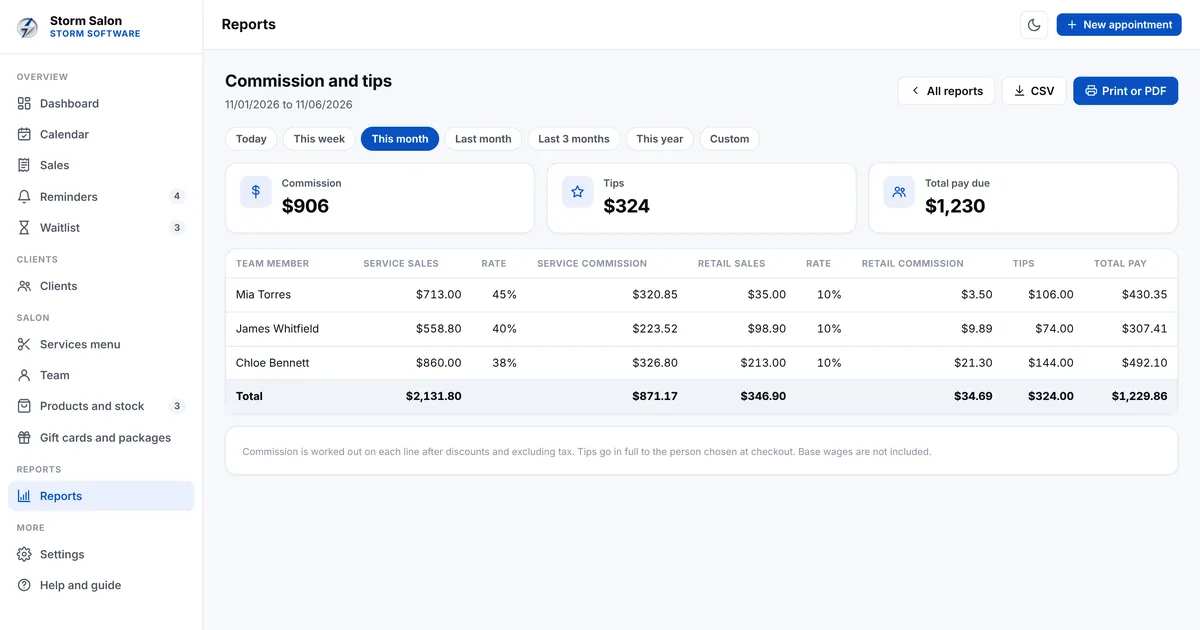
Storm Salon records every sale at checkout, pays tips to the right stylist, supports different commission rates for each stylist and produces a commission and tips report for any pay period. It works offline on your own computer for a one-time price.
See how Storm Salon handles bookings, checkout and commission for $149 once, with no monthly fees.
For getting paid on time by clients, read our guide to invoicing software for small businesses.
The bottom line
Commission suits stylists who are building a following and salons that want control over the client experience. Booth rent suits busy, established stylists who want independence and can carry the risk. Compare the full deal, not just the headline rate, and check your rights and tax position with a local adviser before you change how anyone is paid.
Try our free salon commission calculator.
You may also like: Storm Paws, Storm Books, Storm Coach