
Real Estate Commission Splits Explained: From GCI to Your Net Check
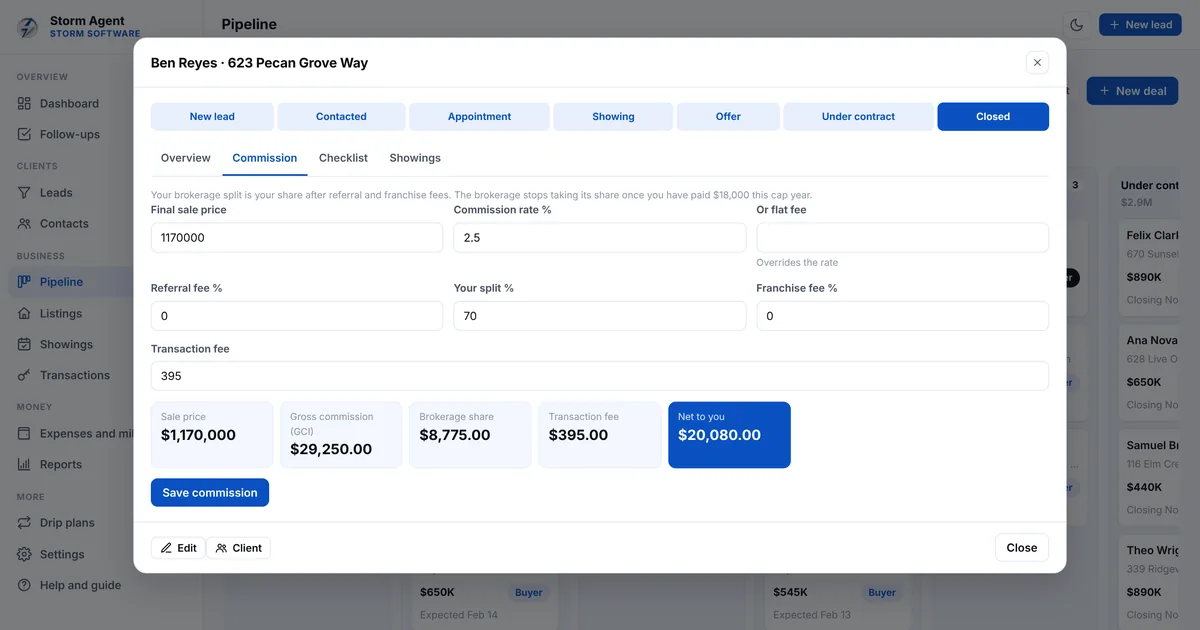
A sale price and a commission rate make it look easy to work out what you earn. In practice, several deductions come off before money reaches your account, and their order depends on your brokerage agreement. This guide follows a commission from the closing table to your net check, explains each fee and shows how a brokerage cap changes your income over a year.
Step 1: the total commission
Commission is usually a percentage of the sale price, though some deals use a flat fee. Rates and who pays them vary by market and have changed in some places, so always work from what is written in the listing and buyer agreements for that deal.
On a 450,000 sale at 5%, the total commission is 22,500.
Step 2: your side's share, or GCI
The total is often shared between the listing side and the buyer side. If your side receives half, your gross commission income, or GCI, on the deal is 11,250. GCI is the number most brokerages and agents use to track production, and it is the starting point for everything that follows.
Step 3: referral fees
If another agent or a referral network sent you the client, a referral fee usually comes off first, commonly somewhere around 20 to 35% of your side. It is agreed before the deal, so record it as soon as the lead comes in, not at closing.
Step 4: franchise and brand fees
Franchise brands often take a royalty, frequently around 6%, and some take it before the brokerage split while others take it after. The order matters. A fee taken before the split reduces the amount the split is calculated on.
Step 5: the brokerage split and cap
Your brokerage keeps an agreed share, such as 70/30 or 80/20 in your favor. Many brokerages also have an annual cap: once you have paid a set amount in splits, you keep the full split for the rest of the year. Some cap models reset on your anniversary date rather than January.
Caps make your income very uneven across the year. Early deals feel expensive, and deals after you cap feel much better. Tracking how much of the cap is left helps you plan cash flow.
- Know your split, your cap amount and when it resets
- Check whether fees count toward the cap
- Track cap progress after every closing
Step 6: transaction and admin fees
Many brokerages charge a flat fee per closing for compliance, file review or admin. It often still applies after you cap. It is small next to the split, but it adds up over a busy year.
A worked example
Take that 450,000 sale with 11,250 GCI, a 6% franchise fee before the split, a 70/30 split and a 395 transaction fee. The franchise fee is 675, leaving 10,575. The brokerage keeps 30%, or 3,172.50. After the transaction fee, your net is 7,007.50, about 62% of GCI.
Now add a 25% referral fee and assume only 2,000 is left on your cap. The referral takes 2,812.50, the franchise fee drops to 506.25, and the split stops at 2,000 because of the cap. Your net becomes 5,536.25.
Try your own deal in our free real estate commission calculator. It handles referral fees, franchise fees, splits, caps and transaction fees.
From commission to real income
Net commission is still not take home pay. Marketing, MLS and association dues, licensing, insurance, vehicle costs and tax all come out of it. Tracking expenses and mileage alongside each deal shows what your business actually earns.
Storm Agent tracks commission per deal with your rate, referral, franchise fee, split, cap and transaction fee, then rolls it into GCI and net income reports with expenses and mileage. It also runs your leads, pipeline, listings, showings and transaction checklists, offline on your own device.
See how Storm Agent manages deals and commission for $149 once, with no monthly fees.
For billing your own clients or referral partners, read our guide to invoicing software for small businesses.
Common split models
Brokerages structure splits in many ways, and the right one depends on how much you sell and what support you need. A graduated split starts at a lower share for you and improves as your production grows. A capped split charges a percentage until you reach the cap, then little or nothing. A 100% model lets you keep the full commission in exchange for monthly and per transaction fees.
Team agents often have an extra layer: the team takes a share before or after the brokerage split, sometimes in exchange for leads. Ask exactly what each share pays for, and model a slow year as well as a good one before you sign.
- Graduated split: improves as you sell more
- Capped split: pay a percentage until the cap, then keep more
- 100% model: keep the commission, pay fixed fees
- Team split: an extra share, often in exchange for leads
Track every deal from lead to closing
Commission is easy to forget about until a check arrives that is smaller than expected. Recording the expected commission, referral fee and split as soon as a deal goes under contract lets you see your pipeline in real money and plan for quiet months.
It also helps at tax time and when you review your year. Knowing which lead sources produced the most net income, not just the most deals, shows where to spend your marketing budget next year.
The bottom line
Start from GCI, then take off referral fees, franchise fees, your brokerage split up to any cap, and transaction fees. Know the order your brokerage uses, track your cap through the year, and always confirm final figures with your brokerage before you count on them.
Try our free real estate commission calculator.
You may also like: Storm Rentals, Storm Contracts, Storm Books