
How to Calculate Weighted Grades: A Simple Guide With Examples
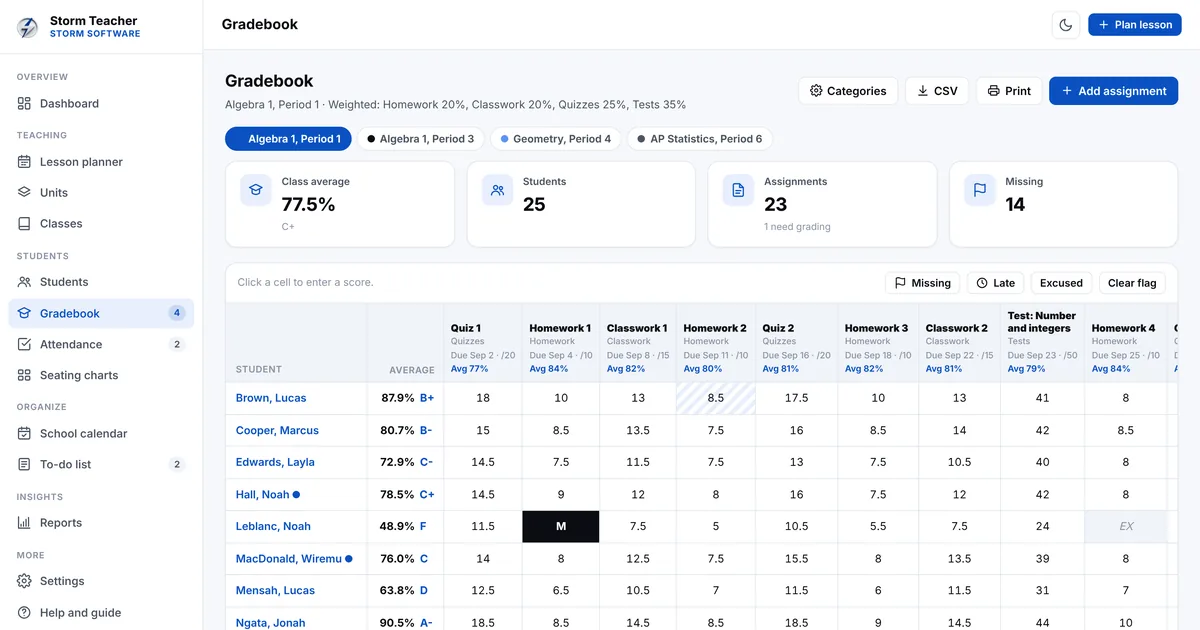
Most classes do not count every assignment equally. Tests might be worth 35% of the grade while homework is worth 20%, even though there is far more homework. That is a weighted grade. This guide shows teachers, students and parents how to calculate one by hand, what to do when a category has no grades yet, how to turn the result into a letter grade, and how to work out the score needed on a final exam.
What a weighted grade is
In a weighted system each category of work counts for a fixed share of the final grade. The syllabus usually lists the categories and their weights, for example Homework 20%, Classwork 20%, Quizzes 25% and Tests 35%. The weights normally add up to 100%.
Within a category, each assignment is averaged first. The category averages are then combined using the weights. This is why one test can move a grade more than several homework assignments.
The formula in three steps
Multiply each category average by its weight, add those results, then divide by the total of the weights. If the weights add up to 100, dividing by 100 gives the weighted average as a percentage.
- Step 1: find the average score in each category
- Step 2: multiply each average by that category's weight
- Step 3: add the results and divide by the total of the weights
A worked example
Say a student has Homework 92% (weight 20), Classwork 88% (weight 20), Quizzes 81% (weight 25) and Tests 76% (weight 35). Multiply each pair: 92 x 20 = 1840, 88 x 20 = 1760, 81 x 25 = 2025 and 76 x 35 = 2660. The total is 8285. Divide by the total weight of 100 and the weighted average is 82.85%.
Notice that the simple average of the four categories would be 84.25%. The weighted grade is lower because the lowest score, tests, carries the most weight.
Check your own numbers with our free weighted grade calculator. It updates as you type, warns you if the weights do not add up to 100% and shows the score needed on the final.
When a category has no grades yet
Early in a term some categories may be empty. Most gradebooks leave an empty category out and divide by the weights that do have scores. If only Homework (20) and Quizzes (25) have grades, divide by 45 instead of 100.
Leaving the category out is different from counting it as zero. A zero for a category that has not started would make the grade look far worse than it is. Missing work is different again: a missing assignment that was due usually counts as zero until it is handed in.
Points based grading versus weighted categories
Some teachers use total points instead of weights. Every assignment is worth a number of points and the grade is points earned divided by points possible. A 100 point test then counts ten times as much as a 10 point quiz.
Points are simple to explain, but the balance between categories shifts as the term goes on. Weighted categories keep the balance fixed, which is why many schools ask for them.
Turning a percentage into a letter grade
A common US scale is A for 90 to 100, B for 80 to 89, C for 70 to 79, D for 60 to 69 and F below 60. Plus and minus grades usually cover the top and bottom three points of each band, so 82.85% is a B minus.
Schools set their own scales, and other countries use different systems such as GCSE grades 9 to 1 or A to E. Always check the scale in the syllabus or school policy.
What score is needed on the final
To find the score needed on a final exam, take the target grade, subtract the current grade multiplied by the share of the course already graded, then divide by the final's weight.
With a current grade of 82.85% and a final worth 20%, the rest of the course counts for 80%. To finish with 80% overall: (80 minus 82.85 x 0.8) / 0.2 = 68.6% on the final. To finish with 90%, the final would need 118.6%, which is out of reach without extra credit.
Common mistakes
The most common mistake is averaging all assignments together and ignoring the weights. Others are counting an empty category as zero, using weights that add up to more or less than 100%, and rounding each category before combining them, which can shift a borderline grade.
- Averaging every assignment equally
- Counting empty categories as zero
- Weights that do not add up to 100%
- Rounding too early
Keeping a weighted gradebook for a whole class
One student is easy to work out by hand. Thirty students across four classes is not. A spreadsheet works until formulas break, a category weight changes or someone asks why a grade moved.
Storm Teacher keeps a full gradebook with weighted categories or total points. Averages update as you type, M marks missing work and EX excuses it, and switching the grading scale converts every grade at once. It works offline, and student data stays on your own device.
See how Storm Teacher handles lesson plans, grades, attendance and seating charts for $49 once, with no yearly renewal.
The bottom line
Multiply each category average by its weight, add the results and divide by the total weight. Leave out categories with no grades yet, check the letter scale your school uses, and use the final exam formula to see exactly what is still possible.
Try our free weighted grade calculator.
You may also like: Storm Coach, Storm Creator, Storm Wedding