
Homeschool Record Keeping: Attendance, Hours, Grades and Transcripts
Good homeschool records protect you, help you plan and make high school transcripts far less stressful. They do not have to take over your evenings. This guide covers which records most families keep, how much detail is enough, and how to turn record keeping into a five minute daily habit instead of an end of year scramble.
Check what your state or country requires
Requirements vary widely. Some places ask for nothing beyond a notice of intent. Others expect attendance records, a set number of days or hours, a portfolio review or standardized testing. Start by checking the current rules where you live, then keep a little more than the minimum. Records you never need are cheap; records you suddenly need and do not have are not.
This guide is general information, not legal advice. Your state education department or a local homeschool association is the best source for the rules that apply to you.
The five records most families keep
Whatever your requirements, these five records cover almost every situation, from a portfolio review to a college application.
- Attendance: which days school happened, and for some states, hours by subject
- Lesson plans or a log of what was covered
- Grades or progress notes for each subject
- A portfolio of work samples across the year
- For high school: courses, credits and a transcript with GPA
Attendance and hours without the stress
Attendance is easiest when it is a single click at the end of each school day. Mark the day as present, a field trip, a sick day or a holiday, and you have your days. If your state counts hours, log them by subject as you go rather than estimating them later.
Plan your year against your target. If you need 180 days, a calendar that shows days completed versus days remaining lets you spot a shortfall in October instead of May.
Grades and progress
Grades do not need to look like a public school report card, especially in the early years. A simple record of assignments, scores and comments per subject is enough. For older children, averages and letter grades per course make the step to a transcript straightforward.
Many families also keep a short weekly note: what went well, what was hard and what to adjust. Those notes are often more useful for planning than the grades themselves.
Building a portfolio that tells the story
A portfolio shows growth. Aim for a few samples per subject per term: a piece of writing from September and one from May, a math test, a science project photo, a reading list. Date everything. Digital portfolios are far easier to keep tidy than a box of paper, and photos of hands-on work count.
High school transcripts and GPA
For high school, start the transcript in ninth grade and update it every semester. List each course, the year taken, the final grade and the credits earned. A typical full-year course is one credit and a semester course is half a credit.
GPA is usually calculated on a 4.0 scale, where A is 4, B is 3 and so on, weighted by credits. Some families also show a weighted GPA that gives honors or advanced courses an extra point. Show both if you use weighting, and explain your grading scale on the transcript.
- Course title and year
- Final grade and credits
- Cumulative credits and GPA
- Your grading scale and, if used, how weighting works
- Signature and date as the issuing school administrator
Make it a five minute habit
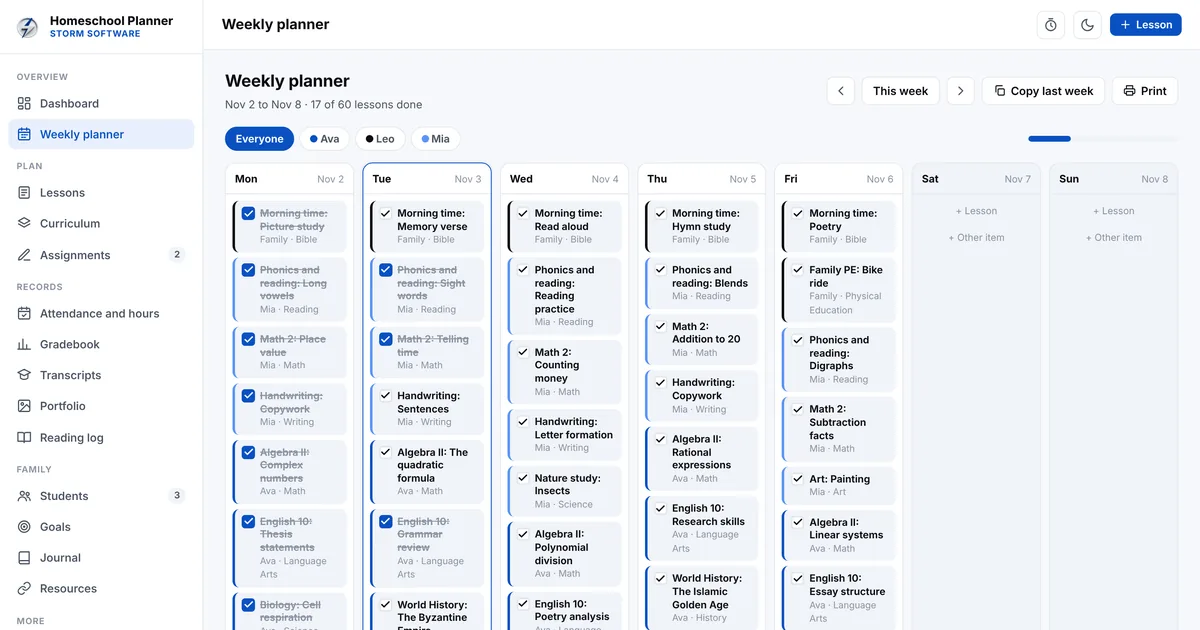
The families who keep great records do not spend more time on them. They do a little every day: tick attendance, log what was covered, add a photo of good work. A homeschool planner that holds lessons, attendance, grades, portfolio and transcripts in one place makes that habit almost automatic, because the record keeping happens as part of planning.
Storm Homeschool keeps all of this together for every child. See the homeschool planner software, $39 once with no subscription.
How long to keep records
A sensible rule is to keep attendance, grades and portfolio samples for at least a few years, and to keep high school transcripts and course descriptions permanently. Colleges, employers and even the military may ask for a transcript years later. Back up digital records and keep a printed copy of each final transcript.
Common questions
Do I need to grade young children? Usually not. Many families keep progress notes and portfolio samples in the early years and introduce grades in middle school or high school.
How do I count high school credits? A common approach is one credit for a full-year course of roughly 120 to 180 hours, and half a credit for a semester course. Write down the approach you use and apply it consistently.
Can one planner handle several children? It should. Each child needs their own attendance, grades and portfolio, but planning the week together on one screen saves a lot of time.
The bottom line
Know your local requirements, keep the five core records, and update them daily rather than yearly. Your future self, and any reviewer or admissions office, will thank you.
Planning family devotions alongside school? Read how to start a Bible reading plan and stick to it.
You may also like: Storm Bible Study, Storm Meal Planner, Storm Fitness