
Voltage Drop Explained: How to Size Cable for Long Runs
A circuit can be protected correctly, sized for its current and still perform badly at the far end. The reason is usually voltage drop. Motors run hot, LED drivers flicker, EV chargers throttle back and customers call you back. This guide explains what voltage drop is, how to calculate it for single phase, three phase and DC circuits, which limits electricians commonly work to, and how to choose a cable size that keeps a long run within them.
What voltage drop is and why it matters
Every conductor has resistance. When current flows through it, some voltage is used up pushing that current along the cable, so the voltage at the load is lower than the voltage at the panel. On a short run the loss is tiny. On a long run with a heavy load it can be large enough to matter.
Too much voltage drop wastes energy as heat in the cable and leaves equipment running below its rated voltage. Motors draw more current and run hotter, lighting dims or flickers, and electronic equipment such as EV chargers and inverters may reduce output or trip on undervoltage. It is one of the most common causes of a job that passes on paper but disappoints in use.
- Longer runs drop more voltage
- Higher current drops more voltage
- Smaller conductors drop more voltage
- Aluminium drops more than copper of the same size
The voltage drop formulas
Start with the resistance of one conductor: resistivity multiplied by length, divided by cross-sectional area. Copper at around 75°C has a resistivity of roughly 0.0211 ohm square millimetres per metre. Aluminium is about 0.0346, roughly 1.6 times higher.
For single phase and DC circuits the current flows out on one conductor and back on the other, so the voltage drop is 2 multiplied by the current multiplied by the resistance of one conductor. For a balanced three phase circuit it is the square root of 3, about 1.732, multiplied by the current multiplied by the resistance of one conductor.
To turn that into a percentage, divide the voltage drop by the supply voltage and multiply by 100. US electricians often use the equivalent K factor method from the NEC tables, and UK, Australian and New Zealand electricians often use millivolt per amp per metre values from their wiring rules. All of them give results in the same range for ordinary circuits.
- Single phase or DC: VD = 2 x I x R
- Three phase: VD = 1.732 x I x R
- R = resistivity x one-way length / conductor area
- Percent drop = VD / supply voltage x 100
How much voltage drop is acceptable?
The limit depends on where you work, so your local code always has the final word. As a rule of thumb, many electricians aim for no more than 3% on a branch circuit and no more than 5% in total from the service to the furthest outlet.
In the US those figures come from informational notes in the NEC, which recommend rather than require them, although some local codes and specifications make them mandatory. In the UK, BS 7671 gives typical limits of 3% for lighting and 5% for other uses on a public supply. In Australia and New Zealand, AS/NZS 3000 sets a 5% limit from the point of supply to any point in the installation. Sensitive equipment may need tighter limits, so check the manufacturer's instructions as well.
Worked example in AWG and feet
Take a 40 amp load on a 240 volt single phase circuit, 120 feet from the panel, wired in 8 AWG copper. The one-way length is about 36.6 metres and 8 AWG has an area of about 8.37 square millimetres, so one conductor has a resistance of about 0.092 ohms.
The voltage drop is 2 x 40 x 0.092, about 7.4 volts. That is about 3.1% of 240 volts, just over the 3% guideline, leaving about 232.6 volts at the load. Moving up to 6 AWG copper cuts the drop to about 4.6 volts, or 1.9%, comfortably inside the limit. On a long garage or outbuilding run like this, sizing up one step is often the cheapest fix.
Worked example in mm² and metres
Now a 32 amp single phase circuit at 230 volts, such as a typical home EV charger, running 30 metres in 6 mm² copper. One conductor has a resistance of about 0.106 ohms, so the voltage drop is 2 x 32 x 0.106, about 6.8 volts or 2.9%.
That is inside 3% but with little margin, and continuous loads like EV chargers are often sized at 125% of their current. On a longer run, or if the cable is grouped or in insulation and needs derating anyway, 10 mm² is the safer choice. The same circuit in 10 mm² drops about 4 volts, or 1.8%.
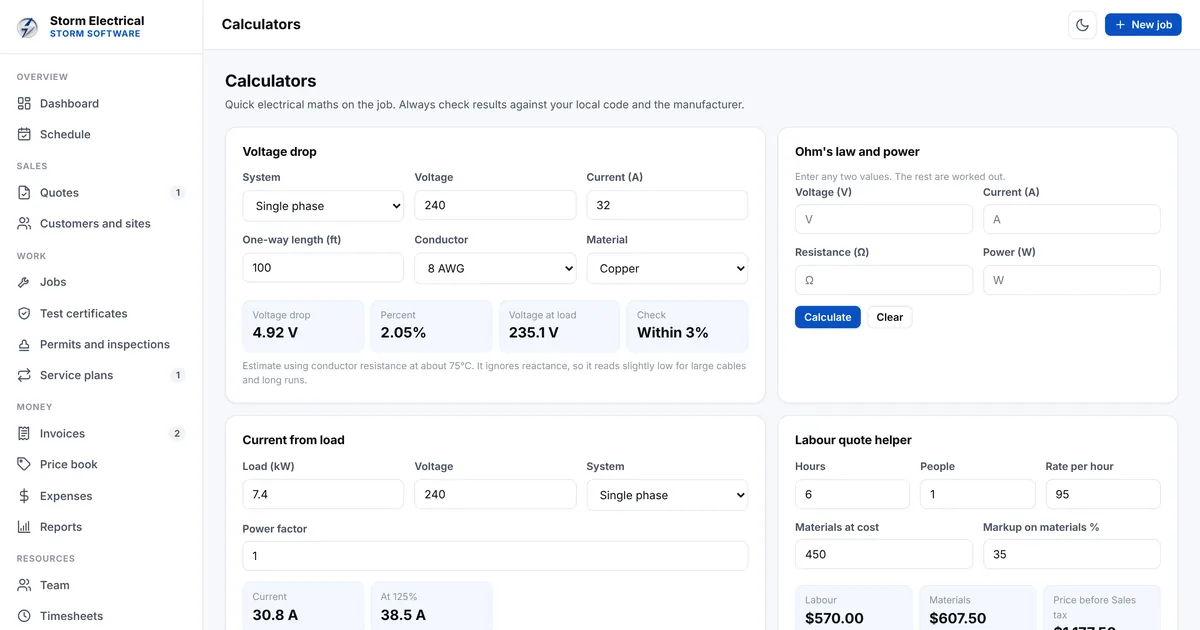
You can try both examples yourself in our free voltage drop calculator. It works in AWG or mm², shows the percentage and suggests the smallest size that keeps you inside your limit.
Practical tips for long runs
Voltage drop is only one check. The conductor still has to carry the current under your installation conditions, and the protective device still has to protect it and disconnect in time under fault. Size for current first, then check voltage drop, then check fault loop impedance where your rules require it.
- Measure the real route, not the straight line, and add for drops and rises
- Enter the one-way length; the formulas already account for the return path
- Check voltage drop before quoting, so a larger cable is priced in from the start
- Consider a higher voltage or a sub panel near the load for very long runs
- Allow extra margin for motors, which draw several times their running current at start
- Record the cable size, length and readings on your test certificate
Keeping the numbers with the job
The calculation is quick. What tends to go missing is the record: which cable you chose, why, and what the circuit measured when you tested it. That information matters when a customer asks why a quote included heavier cable, or when you come back years later to add a load to the same circuit.
Storm Electrical keeps the cable run with the job and the quote, records the circuit and its readings on a test certificate styled for the US, UK, Australia or New Zealand, and includes voltage drop, Ohm's law and load current calculators that work offline on site.
See how Storm Electrical handles quotes, scheduling, test certificates and invoices for $199 once, with no monthly fees.
For the business side of running jobs, read our guide to invoicing software for small businesses.
The bottom line
Voltage drop comes down to current, length, conductor size and material. Work out the drop, compare it with the limit your code uses, and size up when you are close. A few minutes with a calculator before you quote saves a callback after the job is finished.
Try our free voltage drop calculator.
You may also like: Storm Builder, Storm Mechanics, Storm Books