
How to Start a Bible Reading Plan and Actually Stick to It
Every January, many people start a plan to read the whole Bible in a year. By February a lot of those plans have quietly stopped. The problem is rarely desire. It is usually a plan that does not fit real life, and no way to recover after missing a few days. This guide covers how to choose a plan you can keep, a simple way to study instead of just reading, and how to get back on track without starting over.
Choose a plan that fits your season
The Bible has 1,189 chapters. Reading it all in a year means a little over three chapters a day, which takes most people fifteen to twenty minutes. That is very achievable for some seasons of life and unrealistic for others.
If a full year plan has not worked before, start smaller and build momentum. Finishing a shorter plan is better than abandoning a longer one.
- Whole Bible in a year: about three to four chapters a day
- New Testament in 90 days: about three chapters a day
- Gospels in 30 days: about three chapters a day
- Psalms and Proverbs: a short daily reading that pairs well with any plan
- A custom plan: a book or theme you want to go deeper in
Read with a method, not just a checklist
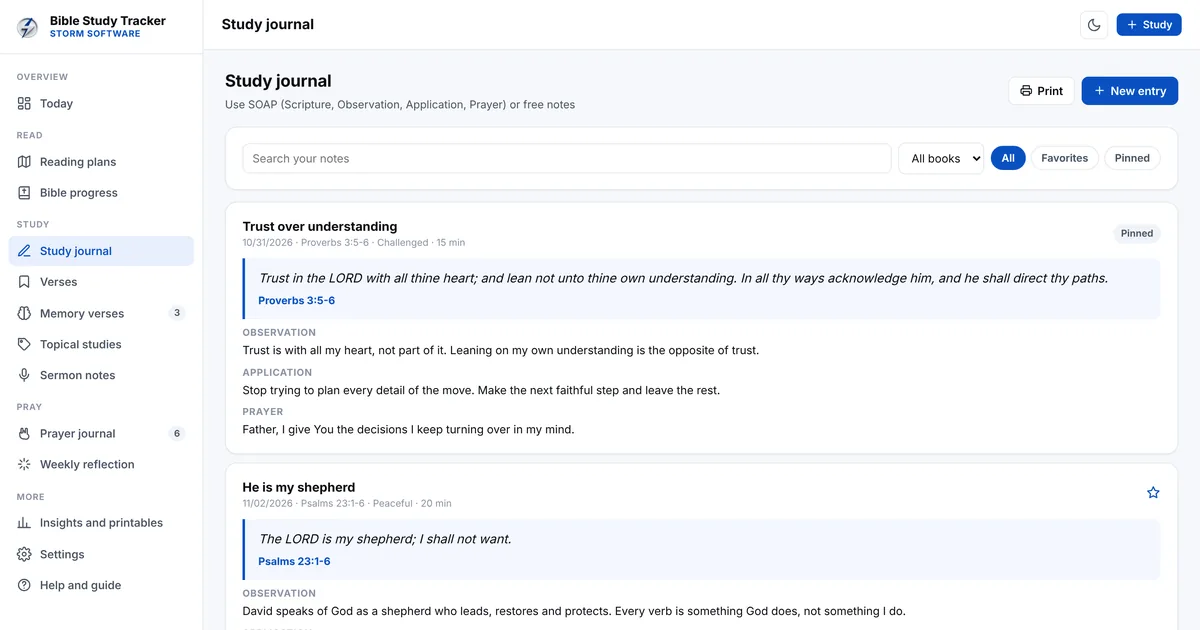
Ticking off chapters builds a habit. Studying a verse or two each day builds understanding. The SOAP method is a simple way to do both in a few minutes.
Pick one verse or short passage from today's reading that stood out, and write four short notes about it.
- S for Scripture: write out the verse
- O for Observation: what does it say, and what was happening at the time?
- A for Application: what does it mean for your life today?
- P for Prayer: a short prayer in response
Keep a prayer list you can look back on
A prayer journal turns prayer from a vague intention into something you can return to. Write down each request with the date, mark it when you pray, and record how it was answered. Looking back over months of answered prayers is one of the most encouraging things a journal can do.
Reading the Bible in a year: what to expect
A year-long plan has a rhythm. The early chapters of Genesis and Exodus read quickly and are full of story. Leviticus and Numbers are where many readers stall, because the laws and lists feel slow. Knowing that in advance helps: read them for the big picture of how God related to His people, and do not worry about absorbing every detail on the first pass.
Many plans mix the Old and New Testaments each day, or add a Psalm, so you are never stuck in one difficult book for weeks. If your current plan has stalled in a tough section, switching to a mixed plan can be enough to get going again. Remember that reading the whole Bible is not a race. Finishing in fourteen months still means you read the whole Bible.
Memorize a verse a week
Memory verses stick best with short, frequent reviews. Read the verse, then try to say it using only the first letter of each word as a prompt. Review new verses daily and older ones less often. Within a few months you will carry a small library of Scripture with you.
What to do when you fall behind
You will miss days. Everyone does. What matters is what happens next. The worst option is trying to read a week of chapters in one sitting, which turns reading into a chore. Two better options: add a little catch-up to each of the next few days, or simply reset the plan to start from today and accept a later finish date.
Treat a missed day as information, not failure. If you keep missing the same day of the week, that day needs a shorter reading or a different time.
Small habits that make it last
Tie reading to something you already do every day, like your morning coffee. Keep your Bible and journal in the same place. Track a streak, but do not let a broken streak end the habit. And once a week, take five minutes to reflect: what did you learn, and what will you carry into next week?
Add sermon notes and topical studies
Your reading plan does not have to be the only way you study. Writing brief sermon notes each Sunday, with the main points, key verses and one action step, helps the message stay with you through the week. A topical study, following a theme like grace, forgiveness or anxiety through several books, is a good change of pace between longer plans.
Common questions
Which translation should I use? The one you will actually read. Many people use one translation for daily reading and compare another when studying a passage closely.
Is it better to read in the morning or evening? Whichever time you can protect consistently. For many people, mornings work best because the day has not yet filled up.
What if I only have five minutes? Read a short passage and write one SOAP note. Five focused minutes every day beats an hour once a month.
Keep it all in one quiet place
Paper journals are lovely, but they are hard to search and easy to lose. A Bible study tracker can hold your reading plans, SOAP journal, prayer list, memory verses and sermon notes together, with catch-up built in when you fall behind.
Storm Bible Study does this privately and offline, with no ads or subscription. See the Bible study tracker, $39 once.
Teaching your children at home too? Our guide to homeschool record keeping may help.
You may also like: Storm Homeschool, Storm Fitness, Storm Meal Planner