
30 Day Home Workout Challenge: How to Plan It and Track Progress
A 30 day challenge is long enough to build a habit and short enough to feel achievable. Done at home with no equipment, it removes most of the excuses that stop people training. This guide covers how to structure the month, which habits to pair with it, and how to track progress so you can see the change even when the scale is slow.
Structure the month in four weeks
Do not start at full intensity. The first week is about showing up, learning the movements and finishing every session. Each week after that, add a little: a few more reps, a slightly longer hold or one extra round. That gradual increase is what drives progress and keeps you clear of the soreness that ends many challenges in week one.
- Week 1: learn the movements, short sessions, focus on form
- Week 2: add reps or a round, keep one full rest day
- Week 3: the hardest week, slightly longer sessions
- Week 4: hold your gains, finish strong and test yourself on day 30
A balanced week with no equipment
Mix the type of training across the week so you can keep going without overworking the same muscles. A chair and a bit of floor space are enough.
- Full body: squats, push-ups or incline push-ups, lunges, glute bridges
- Cardio and core: marching or jogging in place, mountain climbers, planks
- Lower body: split squats, wall sits, calf raises
- Upper body: chair dips, push-up variations, plank shoulder taps
- Mobility and stretching on easier days
- At least one full rest day each week
Pair the workouts with daily habits
Workouts are only part of the picture. A short list of daily habits makes the month far more effective, and ticking them off gives you a small win even on rest days. Keep the list short: five or six habits you can realistically hit.
- Workout or planned rest
- Drink your water target
- Hit a protein goal
- Stretch for five minutes
- Reach a daily step count
- Sleep seven hours or more
Warm up, cool down and form
A few minutes of preparation makes every session safer and more effective. Start with three to five minutes of easy movement such as marching in place, arm circles and gentle squats to raise your heart rate and loosen your joints. Finish with a few minutes of stretching for the muscles you worked.
Form matters more than speed or reps, especially at the start. Slow down, use a mirror or record yourself occasionally, and choose the easier version of any move until you can do it well. Incline push-ups against a chair or wall, half squats and shorter planks are all perfectly good ways to build up. Guided workouts with form tips and easier and harder options for each exercise make this much simpler, because you can scale every move to where you are today.
Track progress beyond the scale
In the first month, body weight can move slowly or bounce around, especially as you start training. Measurements, photos and performance tell a fuller story. Measure your waist, hips, chest, arms and thighs on day one and day 30. Take front and side photos in the same light. And note your personal bests: how many push-ups, how long a plank.
If you are tracking weight too, read why the scale bounces and how trend weight helps.
Make sessions easy to start
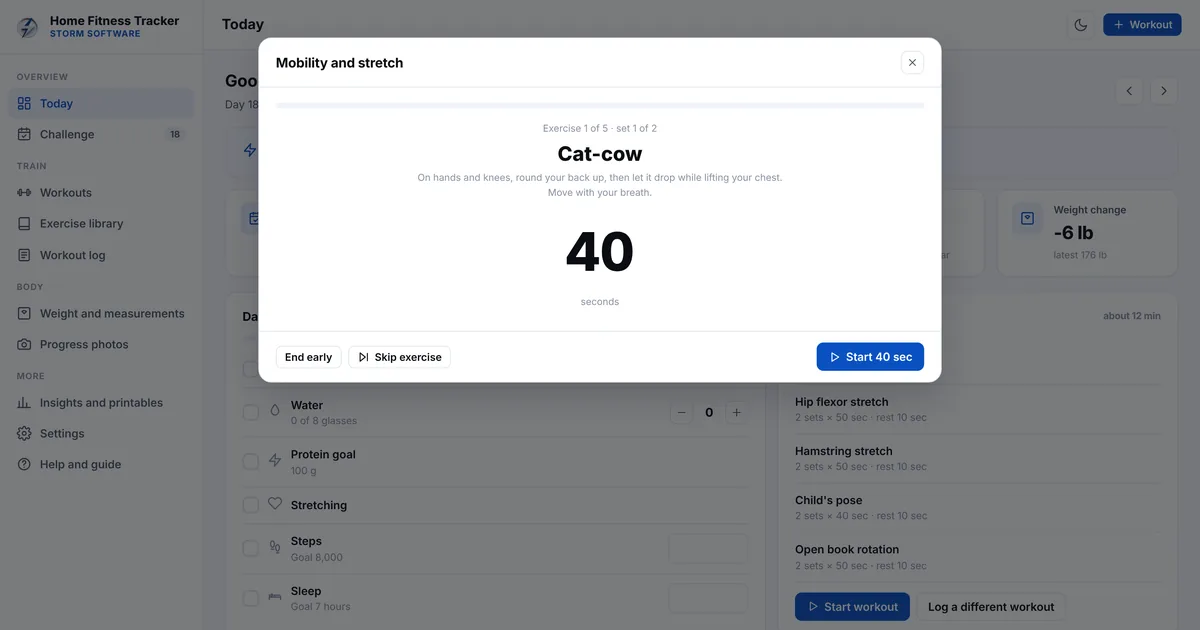
The hardest part of a home workout is pressing play. Remove decisions: plan the whole week in advance, put your workout at the same time each day, and use a guided timer so you are not counting reps and watching the clock at once. Rest timers that start on their own keep sessions short and focused.
What to do after day 30
Finishing is the goal, but it is also a starting point. Most people do best by rolling straight into a second month at a slightly harder level, or extending to 60 or 90 days. Keep the same habits and keep tracking, so the progress you made becomes the new baseline.
Storm Fitness runs 30, 60 or 90 day challenges with guided workouts, habits, measurements and progress photos. See the home workout tracker, $34 once.
Sample first week
Here is a simple first week to show how the structure works. Keep each session to 20 or 25 minutes, including a short warm-up.
- Day 1: full body, 2 rounds of squats, incline push-ups, glute bridges and a 20 second plank
- Day 2: cardio and core, marching in place, mountain climbers, dead bugs
- Day 3: lower body, split squats, wall sit, calf raises
- Day 4: mobility and a long walk
- Day 5: upper body, chair dips, push-up variation, plank shoulder taps
- Day 6: full body, 3 rounds
- Day 7: rest
Common questions
How many days a week should I train? Five or six active days with at least one full rest day works well for most beginners.
Do I need weights? No. Body weight, a sturdy chair and a little floor space are enough for the first months. Progress comes from more reps, slower tempo and harder variations.
What if I miss a day? Do not double up. Pick up the plan where you are, and if needed extend the challenge by a day or two.
A quick safety note
These are general home workouts, not medical advice. If you have an injury, a health condition or have not exercised in a long time, check with your doctor before starting a new program, and always choose the easier version of a move if something hurts.
You may also like: Storm Weight, Storm Meal Planner, Storm Garden